

Views: 0 Author: Site Editor Publish Time: 2026-05-06 Origin: Site


Why do some dish antennas perform better than larger ones? A Parabolic Antenna can focus radio waves into a strong, narrow beam for satellite links, radar, microwave communication, and wireless backhaul. In this guide, you will learn the main types of Parabolic Dish Antenna, how they differ, and how to choose one for real signal needs.
A parabolic dish is selected mainly because it can concentrate radio waves into a narrow, highly directional beam. This focused beam helps a Parabolic Antenna receive weak signals from distant sources or transmit energy accurately toward a target. In practical systems, the antenna type affects how much gain can be achieved, how narrow the beam becomes, and how carefully the antenna must be aligned. For example, satellite communication and point-to-point microwave links usually need strong directivity, while some radar systems may require a wider scanning pattern.
Most Parabolic Dish Antenna types are grouped by two design factors: where the feed is placed and how the reflector is shaped. These details influence efficiency, blockage, installation difficulty, and the best use case.
Design factor | Why it matters in real use |
Feed position | Affects signal blockage, aperture efficiency, and equipment placement |
Reflector shape | Controls beam pattern, wind load, coverage angle, and structural size |
Feed system complexity | Influences cost, alignment requirements, and maintenance difficulty |
Choosing a parabolic dish only by diameter can lead to poor results. A larger reflector may offer higher theoretical gain, but real performance also depends on feed illumination, surface accuracy, and line of sight. At higher frequencies, even small reflector errors can reduce efficiency because the surface must remain accurate within a small fraction of the wavelength. Site conditions also matter: a solid large dish may collect more wind load, while a grid reflector may be more practical for exposed outdoor installations.
Feed design is one of the most practical ways to classify a Parabolic Dish Antenna because the feed is the part that sends or receives radio-frequency energy before the reflector shapes it into a directional beam. Where the feed sits affects blockage, aperture efficiency, mechanical layout, and the amount of space available for RF components. In real projects, this difference often matters more than the dish appearance itself.
Feed design | Basic structure | Main advantage | Common use |
Front feed | Feed placed at the central focal point | Simple and economical | General communication, traditional dish systems |
Offset feed | Feed moved away from the beam path | Less blockage and better efficiency | Satellite TV, VSAT, compact receiving systems |
Cassegrain feed | Main reflector plus convex sub-reflector | Convenient equipment placement | Earth stations, radar, large antennas |
Gregorian feed | Main reflector plus concave sub-reflector | High efficiency and strong beam control | Precision satellite and scientific systems |
A front feed Parabolic Antenna, also called a center-focus or axial-feed antenna, places the feed directly at the focal point in front of the reflector. The feed may be a dipole, a feed horn, or another suitable radiating element, depending on the frequency and system design. This layout is easy to understand because the reflector focuses incoming waves toward the central feed, or reflects transmitted energy outward into a narrow beam.
Its biggest strength is structural simplicity. The design is relatively easy to manufacture, align, and maintain, which makes it useful when cost control is important. However, the feed and its support arms sit in front of the reflecting surface, so they can block part of the signal path. This blockage reduces effective aperture efficiency and can slightly disturb the radiation pattern. For that reason, front feed antennas are often chosen when simplicity is more important than maximum performance.
An offset feed Parabolic Dish Antenna uses only an off-axis section of a larger paraboloid. Instead of placing the feed in the center of the beam path, the feed is mounted to one side, outside the main reflected signal path. This arrangement helps avoid the shadowing problem found in many center-feed designs.
Because the feed does not block the aperture, offset dishes can often achieve better practical efficiency, especially when the reflector is small. This is why the offset design is widely seen in home satellite TV antennas, VSAT terminals, and compact satellite receiving systems. In outdoor wireless networks, compact offset-style dishes such as a 0.4m 5GHz Dish can support focused 5GHz WLAN or WiFi links where manageable size and directional signal control are both important.
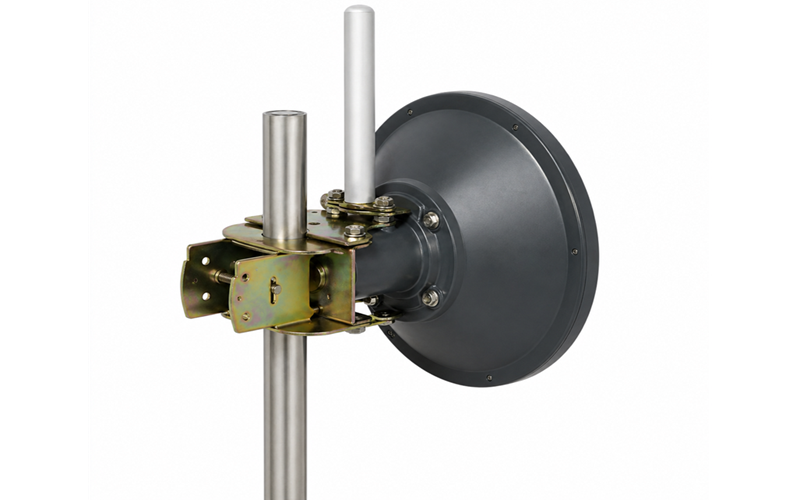
A Cassegrain Parabolic Antenna uses two reflectors: a large main parabolic reflector and a smaller convex secondary reflector near the focal region. The feed is usually positioned closer to the back or center area of the main reflector, while the secondary reflector redirects energy between the feed and the main dish.
This structure is useful when the antenna must handle heavier or more complex RF equipment. Instead of placing all components at the front focal point, designers can keep equipment in a more accessible and protected position. Cassegrain systems are common in large satellite ground stations, radar installations, and professional communication antennas where performance, stability, and equipment layout are important. The design is more complex than a simple front feed antenna, so it usually requires more careful manufacturing and alignment.
A Gregorian parabolic dish antenna is also a dual-reflector system, but it uses a concave secondary reflector rather than a convex one. This difference changes the way the signal is redirected and can improve reflector illumination when the system is carefully designed.
Gregorian antennas are often selected for applications that need high aperture efficiency, strong control of the beam shape, and better polarization performance. They are suitable for precision satellite communication, radio observation, and other systems where signal quality matters more than having the simplest structure. Like Cassegrain designs, they require accurate geometry and alignment, but they can deliver excellent performance in demanding RF environments.
Besides feed arrangement, reflector structure is another important way to classify a Parabolic Antenna. The reflector surface determines how radio waves are shaped after reflection, which directly affects beam pattern, mechanical stability, wind resistance, and installation suitability. In practice, two antennas may both use parabolic geometry but behave differently because their reflector shapes are designed for different coverage needs.
Reflector structure | Beam characteristic | Best suited for |
Standard paraboloidal dish | Narrow pencil beam | Satellite communication, point-to-point links |
Cylindrical parabolic reflector | Fan-shaped beam | Radar scanning, wider coverage in one plane |
Grid parabolic reflector | Directional beam with lower wind load | Outdoor towers, coastal or windy sites |
Cut-parabolic reflector | Customized beam or compact profile | Specialized radar and communication systems |
The standard paraboloidal dish is the classic circular reflector most people associate with a Parabolic Dish Antenna. Its curved surface focuses incoming radio waves toward the feed or reflects transmitted signals into a narrow pencil beam. This high directivity makes it suitable for long-distance communication where the signal must be aimed accurately.
This structure is widely used in satellite communication, point-to-point microwave links, spacecraft communication, and other high-gain receiving systems. Its main advantage is strong directional performance, but it also requires accurate alignment. Since the beam is narrow, even a small pointing error can reduce signal quality, especially at higher microwave frequencies.
A cylindrical parabolic antenna does not form a full circular dish. Instead, its reflector is curved in one direction and relatively straight in the other. Because of this shape, it does not produce the same pencil-like beam as a standard dish. It creates a fan-shaped beam that is narrow in one plane and wider in another.
This beam pattern is useful when a system needs coverage across a wider area while still maintaining directional control. Cylindrical parabolic antennas are often associated with radar scanning and search applications, where the antenna may need to observe a broad sector rather than focus on a single fixed point.
A grid parabolic antenna replaces the solid reflector surface with metal mesh, parallel wires, or a grill-like structure. When the spacing is properly designed for the operating wavelength, the grid can still reflect radio waves effectively while reducing physical weight.
This design is especially useful for outdoor installations. Lower wind resistance makes it practical for tall towers, exposed hillsides, coastal areas, and other sites where a solid dish would place more stress on the mounting structure.
A cut-parabolic dish is a modified reflector made by trimming part of a standard parabolic shape. This adjustment may be used to meet space limits, control beam width, or fit a special mounting arrangement. It is more common in customized communication, radar, and tracking systems than in ordinary consumer installations.
Some Parabolic Dish Antenna designs are not defined only by the basic reflector shape or feed position. They are developed for more specific operating needs, such as receiving signals from multiple directions, reducing interference, or improving feed efficiency at microwave frequencies. These designs are often used when a standard dish cannot fully meet the requirements of a communication, radar, or satellite system.
Design type | Main purpose | Typical value in applications |
Multi-feed parabolic antenna | Handles multiple signal paths | Reduces the need for several separate dishes |
Shrouded parabolic dish antenna | Controls unwanted radiation | Improves performance in interference-heavy areas |
Horn-fed parabolic dish antenna | Improves feed illumination | Supports efficient microwave transmission and reception |
A multi-feed Parabolic Antenna places more than one feed element near the focal region of the reflector. Each feed can be arranged to receive or transmit signals from a different satellite, beam direction, or frequency path. This design is useful in advanced satellite systems where one antenna needs to manage several signal channels without installing multiple independent dishes. It can save mounting space and simplify system layout, although it requires careful feed positioning to avoid signal imbalance.
A shrouded parabolic dish includes a surrounding shield or cylindrical extension around the reflector edge. This structure helps reduce side-lobe radiation, which can otherwise cause or receive unwanted interference. Shrouded dishes are especially useful in dense RF environments, such as urban microwave links, telecom backhaul networks, and carrier-grade installations where nearby signals may affect link quality.
A horn-fed parabolic dish uses a horn antenna as the feed element. Horn feeds are common at microwave frequencies because they can illuminate the reflector efficiently and provide better control over the radiation pattern. This makes them suitable for radar, satellite communication, and professional RF systems where stable directivity and controlled beam shaping are important.
Choosing the right Parabolic Dish Antenna starts with the job it must perform. A dish used for home satellite reception does not need the same structure as one used in a large earth station, radar system, or long-distance microwave link. The best choice depends on how the antenna must handle direction, gain, blockage, mounting conditions, and operating frequency.
Application scenario | Suitable antenna type | Why it fits |
Satellite TV reception | Offset feed parabolic dish antenna | Reduces feed blockage and works well in compact receiving systems |
Large satellite ground station | Cassegrain or Gregorian design | Supports high performance and convenient RF equipment placement |
Point-to-point wireless link | Standard or grid parabolic antenna | Provides directional gain for fixed communication paths |
Radar scanning | Cylindrical parabolic antenna | Creates a fan-shaped beam for wider coverage in one plane |
Multi-satellite reception | Multi-feed parabolic antenna | Handles multiple signal paths with one reflector system |
Feed blockage is one of the most important performance differences between antenna types. A front feed design is simple and economical, but the feed and support arms sit in the signal path. This can reduce the effective collecting area of the reflector. An offset feed design moves the feed away from the main beam, which usually improves practical efficiency, especially in smaller dishes. Cassegrain and Gregorian systems use secondary reflectors, so they are more complex, but they can offer strong performance and better placement for heavy or sensitive RF equipment.
The installation site can make one design more practical than another. A clear line of sight is essential because parabolic antennas are highly directional. Wind load, mounting strength, available space, and weather exposure should also be considered before selecting a reflector structure. In exposed outdoor locations, a grid parabolic antenna may be preferred because it reduces wind resistance. In dense urban or telecom environments, a shrouded dish can help limit side-lobe interference and improve link reliability.
The operating frequency affects how accurate the reflector surface and feed alignment must be. Higher-frequency systems use shorter wavelengths, so small shape errors, poor feed positioning, or weak mounting stability can reduce performance. The feed type should also match the required polarization and frequency band. For professional satellite, radar, or microwave systems, reflector precision and correct alignment are often just as important as antenna diameter. For outdoor WLAN or bridge systems, a 0.6m High-Gain Dish may suit longer 5GHz links, while a 5.1–6.4GHz Dish can fit wider frequency coverage needs.

Even when the main Parabolic Dish Antenna types are clear, selection mistakes can still lead to weak reception, unstable links, or unnecessary installation costs. The right choice should consider antenna structure, site conditions, and operating requirements together, not as separate decisions.
A larger dish may provide higher theoretical gain, but size alone does not guarantee better performance. If the feed is poorly matched, the reflector surface is inaccurate, or the antenna is not aligned correctly, much of that potential gain can be lost.
Center-feed structures are simple, but the feed and support arms sit in front of the reflector. This can block part of the signal path and reduce effective aperture efficiency, especially when the dish is relatively small.
Mistake | Possible result |
Choosing only by diameter | Higher cost without expected signal improvement |
Ignoring feed blockage | Reduced efficiency and weaker received signal |
Using the wrong site structure | Wind stress, interference, or unstable performance |
A solid dish is not always ideal for exposed or windy locations because it can create higher wind load. In interference-heavy environments, an unshielded dish may also suffer from unwanted side-lobe signals.
Parabolic Dish Antenna types include front feed, offset feed, Cassegrain, Gregorian, standard paraboloidal, cylindrical, grid, cut-parabolic, multi-feed, shrouded, and horn-fed designs. The right Parabolic Antenna depends on gain needs, feed layout, site conditions, frequency, and budget. Zhengzhou LEHENG Electronic Technology Co., Ltd. provides parabolic antenna options for outdoor wireless communication, where stable signal direction and application fit are key selection factors.
A: A Parabolic Antenna focuses radio waves into a narrow beam for high-gain communication.
A: An offset Parabolic Dish Antenna moves the feed outside the main beam path.
A: A Parabolic Antenna with Cassegrain feed suits large ground stations and heavy RF equipment.
A: A grid Parabolic Dish Antenna reduces wind load while maintaining directional performance.


 External GPS Antenna
  Ceramic antenna
  Internal GPS Antenna
  Surveying Antenna
 Magnet Antenna
  Patch Antenna
  Rubber Antenna
  Screw Antenna
  Spring Antenna
  Other Indoor Coverage Antenna&outdoor Wlan Antenna
 2.4G Antenna
  5.8G Antenna

 Outdoor Yagi TV Antenna


 Ceiling mount antenna
  Wall mount panel antenna
 Fiberglass Antenna
  Panel Antenna
  Parabolic Antenna
  Yagi Antenna


