

Views: 0 Author: Site Editor Publish Time: 2026-08-04 Origin: Site


Choosing the wrong TV coaxial cable can cause signal loss, picture interference, and issues like freezing, pixelation, or signal interruptions. From basic transmission principles and core specification comparisons to precise selection and installation maintenance, this guide will walk you through choosing the right cable to build a stable TV signal system.
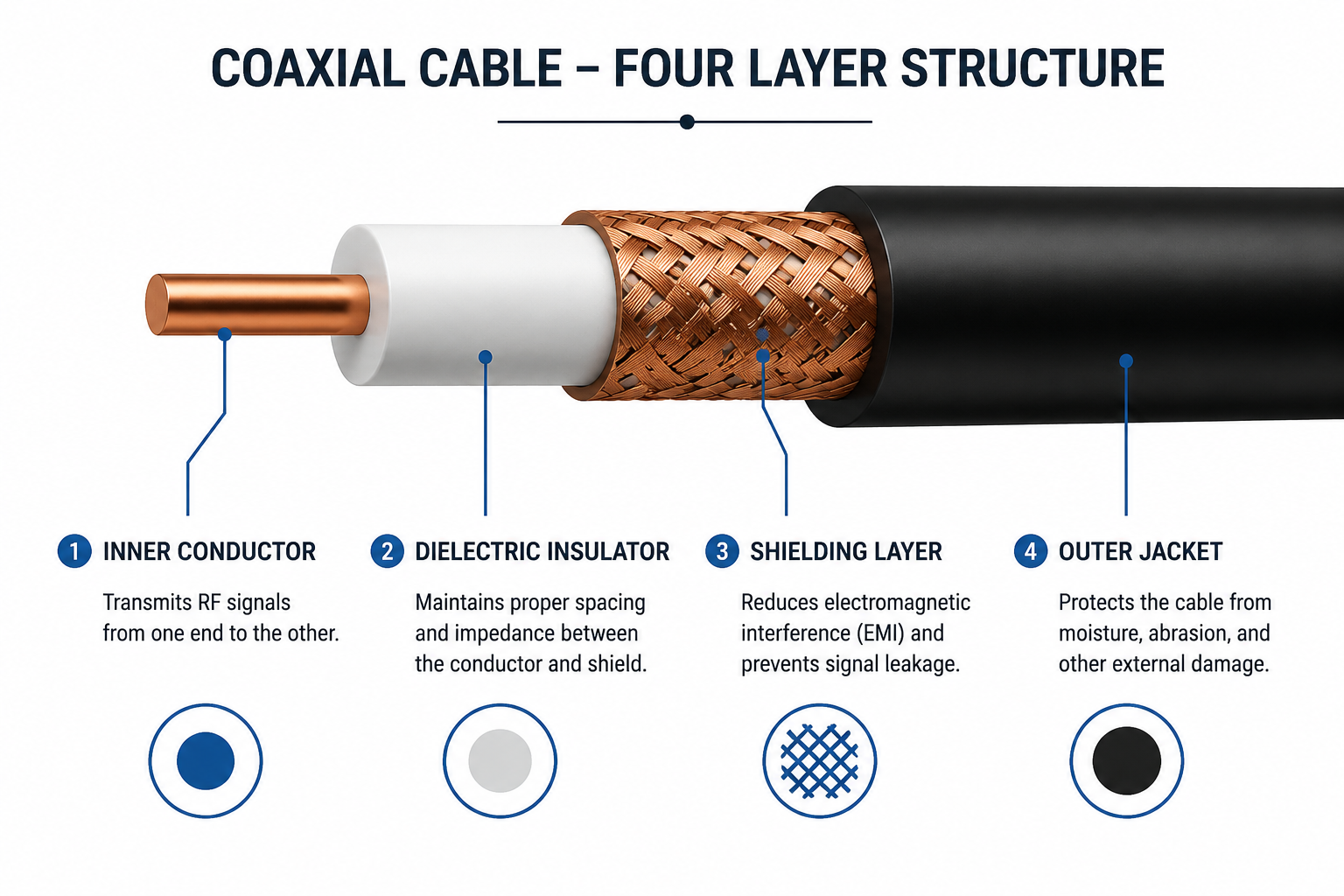
A coaxial cable is an electrical cable designed to transmit high-frequency RF signals, including television broadcasts, cable internet, satellite TV, and other communication signals. It consists of four main layers: the inner conductor, dielectric insulator, shielding layer, and outer jacket.
A coaxial cable transmits high-frequency RF signals through the electromagnetic field formed between the inner conductor and shielding layer. The inner conductor carries the signal, while the dielectric insulator maintains the spacing between the conductor and shield to ensure stable impedance. The shielding layer reduces electromagnetic interference and signal leakage, enabling reliable signal transmission over distance.
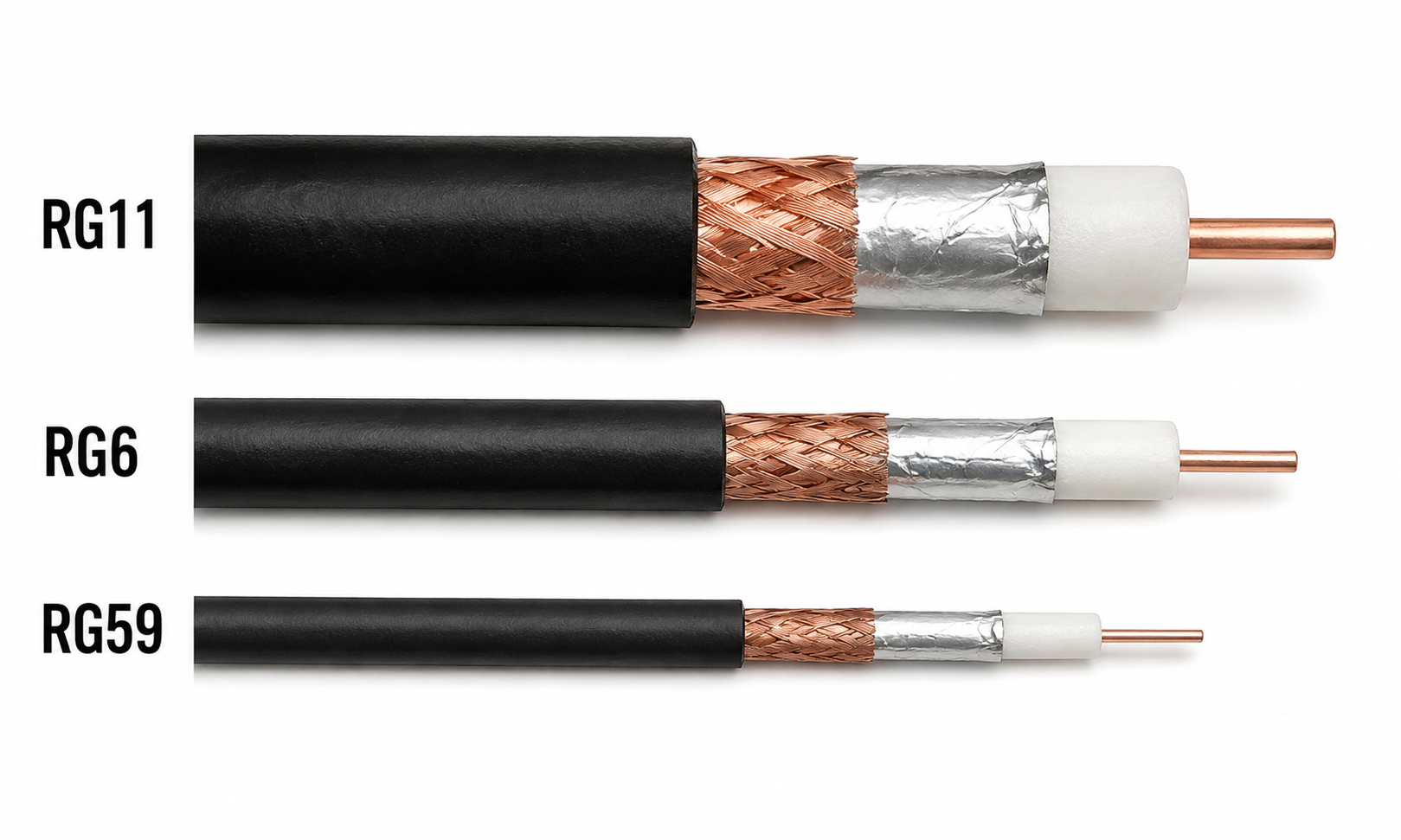
The model designation of a coaxial cable (such as RG6, RG59, or RG11) is not just a label—it directly defines the physical geometry and construction of the cable, which in turn determines its signal transmission capabilities.
Specification | RG59 | RG6 | RG11 |
Center Conductor | 20 AWG | 18 AWG | 14 AWG |
Impedance | 75Ω | 75Ω | 75Ω |
Frequency Range | Up to 3 GHz | Up to 3 GHz | Up to 3 GHz |
Shielding | Single/Dual Shield | Dual/Quad Shield | Dual/Quad Shield |
Signal Attenuation (1 GHz) | ~15–18 dB/100 ft | ~6–8 dB/100 ft | ~4–5 dB/100 ft |
Cable Diameter | ~6.1 mm | ~6.9 mm | ~10.3 mm |
Strengths: Provides low attenuation at frequencies below 50 MHz, making it suitable for low-frequency signal transmission.
Limitations: Signal loss increases significantly in the 50 MHz–3 GHz range, limiting its performance in long-distance and high-bandwidth applications.
Strengths: Offers a good balance between low attenuation and high bandwidth, maintaining stable performance across the 50 MHz–3 GHz frequency range. It is the industry standard for general broadband internet, digital video distribution, and RF signal routing.
Limitations: Compared with RG11, RG6 has higher signal attenuation over long cable runs, especially for distances exceeding 150 ft (45 m).
Strengths: Provides the lowest attenuation among RG59, RG6, and RG11, making it suitable for long-distance transmission over 150 ft (45 m).
Limitaions: The larger cable diameter and heavier construction increase installation difficulty and require a larger minimum bend radius.
Besides cable type, the construction materials and design of a coaxial cable can also affect RF signal quality and transmission performance. When selecting a coaxial cable for broadband, video, or RF systems, factors such as shielding structure, conductor material, cable connector, and jacket material should be considered.
· Shielding structure: Common designs include single-shield, dual-shield, and quad-shield structures. Single-shield cables typically provide around 40–60 dB of shielding effectiveness, while dual-shield and quad-shield cables can reach approximately 70–100 dB, providing better protection against electromagnetic interference (EMI) in high-interference environments.
· Center conductor material: Pure copper conductors provide lower signal loss due to their higher conductivity and lower resistance. Compared with pure copper, copper-clad aluminum (CCA) or copper-clad steel (CCS) conductors typically have around 30–40% higher resistance, resulting in greater signal attenuation over longer cable runs.
· Coaxial cable connectors: Match the connector type to your equipment. F-type connectors are commonly used for broadband applications, BNC connectors are used for CCTV and SDI video systems, while SMA and N-type connectors are widely used for RF applications. Factory-terminated compression connectors are preferred over traditional twist-on connectors, as they provide better 360° shielding against RF leakage and improved moisture protection.
· Outer jacket material: PVC jackets are commonly used for indoor installations, while PE jackets provide better resistance to moisture, UV exposure, and weather conditions for outdoor applications. Under proper installation conditions, outdoor-rated PE cables can typically provide a service life of 10–20 years.
· RG59 (75 Ohm): Thin and highly flexible. Best for tight-space cabinet jumpers and short analog CCTV runs under 50 ft (15 m) where stiffer RG6 cannot easily bend.
· RG6 (75 Ohm): The ultimate industry standard for home TV, satellite, and broadband up to 150 ft (45 m), balancing low attenuation and affordability.
· RG11 (75 Ohm): Heavy-duty, thick 14 AWG cable engineered for minimal signal loss on long runs exceeding 150 ft (45 m).
· RG58 (50 Ohm): Essential for 50 Ohm RF equipment (like radio transceivers and antennas) under 50 ft (15 m). (Note: 75 Ohm RG6 cannot replace RG58 due to critical impedance mismatching).
· Bare Copper (BC): Lower resistance. Essential when the cable carries both power and data (e.g., PoC cameras, satellite LNBs, or inline boosters).
· Copper-Clad Steel/Aluminum (CCS/CCA): Cost-effective for signal-only transmission. Ideal for self-powered devices like TVs and set-top boxes.
· 1-Second Rule: Need to send power through the coaxial cable? Choose BC. Device already plugged into a wall outlet? Choose CCS. (Unsure what you have? Touch a magnet to the center pin—pure copper is non-magnetic, while CCS will stick).
· Dual-Shield (Foil + Braid): Standard 40-60 dB protection, perfect for regular indoor routing.
· Quad-Shield (2 Foils + 2 Braids): Heavy-duty 70-100 dB protection against strong electrical noise.
· Jacket: Indoor flame-retardant PVC (for fire safety); UV-resistant PE for outdoor or direct burial (to prevent sun damage and moisture intrusion).
· F-type connector (75Ω): Widely used in TV and broadband systems. Its low-cost threaded design provides stable mechanical connection and precise 75Ω impedance matching, making it suitable for large-scale cable installations.
· SMA connector (50Ω): Designed for compact RF devices such as WiFi modules, GPS equipment, and wireless systems. Its miniature threaded structure provides reliable high-frequency performance in limited spaces.
· N-type connector (50Ω): Built for outdoor RF applications such as antennas and base stations. Its robust threaded structure offers high mechanical strength, weather resistance, and reliable high-power signal transmission.
· BNC connector (50Ω/75Ω): Commonly used for CCTV, video systems, and test equipment. Its bayonet locking design enables quick tool-free connection while maintaining stable and reliable signal transmission.
Scenario / Environment | Recommended Cable | Conductor Material | Shielding Level | Jacket Material | Connector Type |
Standard Indoor TV / Broadband | RG6 | CCS or Pure Copper | Dual-Shield | Indoor PVC | F-type |
In-Wall Routing / High Interference | RG6 | Pure Copper (BC) | Quad-Shield | Flame-Retardant PVC | F-type |
Outdoor Antenna / Satellite | RG6 | Pure Copper (BC) | Quad-Shield | UV-Resistant PE | F-type |
Long-Distance Yard / Main Line (>45m) | RG11 | Pure Copper (BC) | Quad-Shield | Outdoor/Burial PE | F-type / N-type |
Tight-Space / Short Analog CCTV (<15m) | RG59 | Pure Copper (BC) | Dual-Shield | Indoor PVC | BNC |
50Ω RF Gear / Router Antenna | RG58 | Pure Copper (BC) | Dual-Shield | Standard PVC | SMA / N-type |
· Respect Bend Radius: Keep bend radius at least 5x cable diameter to prevent inner shield damage.
· Use Dedicated Tools: Use proper coaxial cable strippers and compression tools instead of utility knives.
· Outdoor Weatherproofing: Seal outdoor joints (F/N-type) with waterproof tape to stop moisture ingress.
· Separate from Power Lines: Keep at least 30 cm (12 in) away from parallel AC power lines to avoid EMI.
Every splitter introduces some signal attenuation. A standard 2-way splitter reduces signal strength by about 3.5 dB per port, while a 4-way splitter reduces it by 7 dB.
Coaxial cable has multiple concentric layers (center conductor, dielectric insulation, shield braid, and outer jacket). A dedicated coaxial cable stripper has dual preset blades that precisely cut the outer jacket and dielectric simultaneously without nicking the center conductor or cutting the crucial shield wires.
Always choose Compression Plugs for reliable performance.
Screw-on plugs are easy to install without tools but easily loosen and leak RF signal.
Crimp plugs are okay but offer poor weatherproofing.
Compression plugs offer a 360-degree airtight seal, providing superior signal integrity and waterproof protection for both indoor and outdoor use.


 External GPS Antenna
  Ceramic antenna
  Internal GPS Antenna
  Surveying Antenna
 Magnet Antenna
  Patch Antenna
  Rubber Antenna
  Screw Antenna
  Spring Antenna
  Other Indoor Coverage Antenna&outdoor Wlan Antenna
 2.4G Antenna
  5.8G Antenna

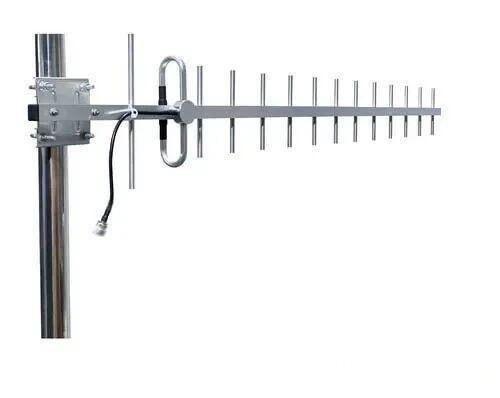 Outdoor Yagi TV Antenna


 Ceiling mount antenna
  Wall mount panel antenna
 Fiberglass Antenna
  Panel Antenna
  Parabolic Antenna
  Yagi Antenna


