

Views: 0 Author: Site Editor Publish Time: 2025-12-15 Origin: Site


When selecting a marine VHF radio antenna, choosing the highest-specification option does not always guarantee the best communication performance. The installation height and position of the antenna are also critical factors that can influence communication range and reliability.

In many cases, selecting a suitable marine VHF antenna and optimizing its installation height and position can improve communication performance more effectively than simply upgrading to a higher-cost model. By providing a clearer signal path and reducing potential obstructions, proper antenna installation allows the VHF antenna to perform closer to its intended capabilities.
A VHF radio antenna is a type of antenna device used to transmit and receive radio signals in the VHF (30 MHz–300 MHz) frequency band. It is an essential component of a wireless communication system, responsible for converting electrical signals from radio equipment into electromagnetic waves that can propagate through space, while also receiving external radio waves and converting them back into electrical signals for voice or data communication. The following is a comparison of VHF, UHF, and HF antennas.
Type | Frequency | Propagation Characteristics | Impact of Antenna Height |
HF Antenna | 3–30 MHz | Can use ionospheric propagation to achieve long-distance communication | Height is less critical for long-range skywave propagation |
VHF Antenna | 30–300 MHz | Mainly relies on line-of-sight propagation and is easily affected by obstacles | Antenna height is critical for extending communication range and maintaining reliable links |
UHF Antenna | 300 MHz–3 GHz | Higher-frequency signals are often used for short-range, high-data-rate communication | Height helps improve coverage, but systems are often designed for shorter distances |
Imagine standing on flat ground and looking into the distance. Your view is limited, but when you move to a higher position, such as the top of a building or an airplane, it feels like you have a “bird’s-eye view ” and can see much farther.
Using a VHF radio antenna follows a similar principle. Since VHF signals mainly rely on line-of-sight propagation, radio signals generally travel along a near-straight path from the transmitting end to the receiving end, rather than easily bending around large obstacles or following the curvature of the Earth like lower-frequency radio waves.
Antenna height should be optimized first because it directly affects the signal path between the transmitting and receiving antennas. If the propagation path is limited, even a higher-gain antenna cannot solve the problem of signal blockage caused by obstacles.
The line-of-sight distance formula can be used to estimate the approximate communication range supported by the current antenna heights under ideal conditions.
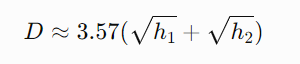
In this formula, D represents the theoretical line-of-sight communication distance, while h₁ and h₂ represent the installation heights of the transmitting and receiving antennas. By comparing the calculated range with the actual communication requirements, users can evaluate whether the current antenna height is sufficient for the intended application.
If the calculated line-of-sight range is below the required communication distance, the required antenna height can be estimated by working backward from the target range and optimizing the installation height accordingly.
If the antenna height is sufficient, the line-of-sight path is clear, and there are no major obstacles between the antennas
A higher-gain antenna can be used to:
· Concentrate more signal energy in the horizontal direction
· Improve signal strength at distant receivers
· Extend communication range and enhance long-distance communication performance
If the received signal at the remote end is weak, but the propagation path is not obstructed:
Increasing antenna gain can:
· Improve the signal strength at the receiving end
· Enhance communication reliability
· Reduce the impact of signal attenuation
Antenna Gain | Application | Description |
3 dBi | Small vessels, short-distance communication | Provides a wider coverage angle but has limited long-range communication capability |
6 dBi | The most common choice for most vessels | Provides a good balance between communication range and signal stability |
9 dBi | Large vessels and long-range communication requirements | Extends horizontal coverage distance but has a narrower vertical beamwidth |
Antenna height is limited by factors such as mast structure, installation cost, and system design. Excessive height may also introduce additional challenges, including longer coaxial cables that increase signal loss, more difficult installation, and higher maintenance requirements. Moreover, once the required line-of-sight range has been achieved, continuously increasing antenna height will provide diminishing improvements in communication performance.
The signal must pass through a coaxial cable before reaching the antenna, and feedline loss can reduce the actual transmitted power and weaken received signals. In marine VHF systems, antennas are often installed at high positions, requiring longer cables and making cable loss more significant. For example, a 6 dBi antenna with a 5-meter low-loss cable may achieve better performance than a 9 dBi antenna with a 20-meter standard cable.
Antenna height directly affects the line-of-sight range of VHF signals. A higher antenna position allows the signal to travel farther before being blocked by the Earth’s curvature or obstacles, improving communication distance.
A marine VHF system typically has a communication range of 5–50 nautical miles (9–93 km), depending on antenna height, vessel size, and environmental conditions. Higher antenna installations can extend the range by improving line-of-sight communication.
Marine VHF antennas are usually made with corrosion-resistant materials such as fiberglass, stainless steel, or aluminum. Fiberglass antennas are widely used because they provide good durability, weather resistance, and protection against harsh marine environments.
A VHF radio antenna should be replaced when it shows signs of physical damage, corrosion, water intrusion, or a noticeable decline in communication performance. For marine applications, frequent exposure to saltwater and harsh weather can affect antenna reliability over time. If the antenna has visible damage, unstable signal performance, or increased VSWR readings, replacement may be necessary.


 External GPS Antenna
  Ceramic antenna
  Internal GPS Antenna
  Surveying Antenna
 Magnet Antenna
  Patch Antenna
  Rubber Antenna
  Screw Antenna
  Spring Antenna
  Other Indoor Coverage Antenna&outdoor Wlan Antenna
 2.4G Antenna
  5.8G Antenna

 Outdoor Yagi TV Antenna


 Ceiling mount antenna
  Wall mount panel antenna
 Fiberglass Antenna
  Panel Antenna
  Parabolic Antenna
  Yagi Antenna


