


GLSDL4540
GLOBAL
8517710000
50PC
Accepted
1000PC/Day
| Quantity: | |
|---|---|
| PDF Export | |


Item | GPS Antenna |
PN | GLSDL4540 |
Frequency Range (MHz) | 1568±9 |
Impedance (Ω) | 50 |
Max power input (W) | 50 |
V.S.W.R | ≤1.5 |
Gain (dBi) | 28 |
Dimensions | 40×45mm |
Weight | 50g |
Polarization | RHCP |
High Gain 28dBi – Exceptional signal amplification ensures reliable positioning even in weak signal environments or with long cable runs.
RHCP Polarization – Right-hand circular polarization matches satellite signals perfectly, minimizing multipath interference and signal loss.
Low VSWR ≤1.5 – Excellent impedance matching maximizes power transfer and reduces signal reflection.
Compact and Lightweight – Small 40×45mm footprint and 50g weight allow easy integration into space-constrained devices.
Built-in Low Noise Amplifier (LNA) – Active design compensates for cable and system losses, ideal for precision applications.
Precision Agriculture – Used in tractor guidance, yield monitoring, and automated farming systems.
Anti jamming antenna/Anti jamming antenna Navigation – Provides stable satellite reception for flight control, surveying, and mapping Anti jamming antennas.
Vehicle Tracking Systems – Enhances GPS signal strength for fleet management, logistics, and anti-theft devices.
Surveying and Mapping – Suitable for high-precision geodetic receivers, GIS data collection, and construction layout.
Timing and Synchronization – Employed in network time servers, base stations, and power grid synchronization requiring accurate GPS timing.
Q: What frequency does the GLSDL4540 antenna operate at?
A: It operates at 1568±9 MHz, covering GPS L1 (1575.42MHz) and nearby GNSS bands such as Galileo E1 and GLONASS L1 (partially).
Q: What does 28dBi gain mean? Is it really that high?
A: 28dBi is the gain including the built-in low noise amplifier (LNA). The passive antenna element gain is lower, but the LNA boosts the signal to 28dBi to overcome cable and system losses.
Q: Is this antenna active or passive?
A: It is an active antenna with an integrated LNA, requiring DC power (typically 3-5V) through the RF cable (bias tee).
Q: What type of connector does it have?
A: The connector is typically SMA male or female (please check product variant), designed for easy connection to GPS/GNSS receivers.
Q: What is the polarization of this antenna?
A: It features Right-Hand Circular Polarization (RHCP), matching GNSS satellite signals for optimal reception.
Q: What is the VSWR specification?
A: VSWR is ≤1.5, indicating excellent impedance matching and low signal reflection.


 External GPS Antenna
  Ceramic antenna
  Internal GPS Antenna
  Surveying Antenna
 Magnet Antenna
  Patch Antenna
  Rubber Antenna
  Screw Antenna
  Spring Antenna
  Other Indoor Coverage Antenna&outdoor Wlan Antenna
 2.4G Antenna
  5.8G Antenna

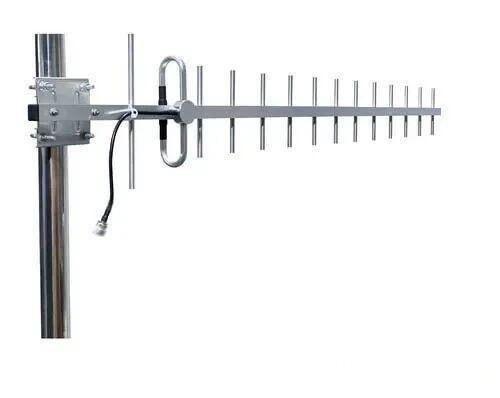 Outdoor Yagi TV Antenna


 Ceiling mount antenna
  Wall mount panel antenna
 Fiberglass Antenna
  Panel Antenna
  Parabolic Antenna
  Yagi Antenna


