

Views: 0 Author: Site Editor Publish Time: 2026-08-26 Origin: Site


Blindly upgrading to 4×4 MIMO may mean paying more antenna cost, installing four bulky coaxial cables, and eventually finding that the network speed has barely improved. However, choosing a 2×2 solution simply to save money may severely limit the performance potential of a high-end router.
How much actual improvement can the additional hardware investment really bring? This guide will move beyond empty technical concepts and provide an in-depth analysis of the key differences between 2×2 and 4×4 MIMO antennas in terms of data throughput, compatibility requirements and return on investment, helping you find the optimal balance between performance and cost.
On a product datasheet, the numbers in 2×2 or 4×4 MIMO specify the exact count of Transmitter (Tx) × Receiver (Rx) RF paths: 2×2 MIMO uses 2 Transmit antennas × 2 Receive antennas to drive up to 2 parallel spatial data streams, while 4×4 MIMO doubles the hardware to 4 Transmit × 4 Receive antennas, enabling up to 4 concurrent streams and doubling theoretical peak speed under identical bandwidth.
However, having a 4×4 rating on your antenna doesn't guarantee you'll always get four active spatial streams in production. Real-world performance strictly enforces The Barrel Principle: your concurrent stream count is capped by the single weakest link across the cell tower, the router modem, and the antenna array. If the serving cell tower only broadcasts a 2×2 signal, your link won't magically unlock four streams. That said, those extra antenna elements don't go to waste—instead of pushing extra data, the system simply shifts them to grab weaker signals and smooth out interference, keeping your link rock-solid even when speeds hit a ceiling.
Furthermore, cellular networks enforce a structural Uplink and Downlink Asymmetry that datasheets rarely explain in detail. A 4×4 MIMO designation primarily refers to downlink(download) capability. Due to strict power consumption and thermal limits on client hardware, uplink (upload) transmissions are routinely constrained to 2×2 MIMO. In field deployments, those extra physical antenna elements and cable runs are primarily working in one direction—pulling data down, not pushing it back up.
Understanding what 2×2 and 4×4 represent is only the first step. The next is how these differences translate into real-world MIMO antenna design and performance.
In real-world deployment scenarios, choosing the right MIMO external antenna configuration is a balance between system throughput, coverage range, link stability, and installation complexity. The core differences fall into four key engineering dimensions:
· 2×2 MIMO: Supports a maximum of 2 parallel data transmission channels simultaneously. Under 100 MHz channel bandwidth and ideal signal conditions, its peak throughput typically stays within the 600–800 Mbps range.
· 4×4 MIMO: Can establish 4 independent spatial channels simultaneously. Under identical bandwidth and optimal signal conditions, the theoretical maximum speed is doubled (a 100% increase) compared to 2×2, pushing peak throughput past 1.2–1.5 Gbps. Even in congested sectors where spectrum resources are tightly constrained, the 4×4 configuration extracts 30%–50% more practical throughput out of the existing network without requiring extra channel bandwidth.
· 2×2 MIMO: Equipped with only 2 radiating elements for signal reception. In fringe coverage areas—such as locations over 3 km from the cell tower or behind multiple thick walls—its ability to capture attenuated signals is limited. Packet loss rates can easily climb above 15%, leading to sharp speed drops or intermittent connection loss.
· 4×4 MIMO: Increases internal radiating elements to 4, using spatial diversity and signal combining techniques to boost effective reception strength by roughly 3 dB. At the physical layer, a 3 dB gain effectively doubles the captured signal energy, extending usable coverage distance by approximately 15%–20%. In weak coverage zones, a 4×4 array exhibits much higher sensitivity, capturing attenuated signals effectively while suppressing packet loss below 3%, directly reducing retransmission overhead to maintain a smooth, uninterrupted connection.
· 2×2 MIMO: In obstructed environments with dense high-rises, metallic frameworks, or industrial layouts, radio waves bounce off structural surfaces before reaching the antenna. This easily induces destructive phase interference (cancellation) at the receiver, triggering sudden throughput dips and causing latency (Ping) to spike from a normal 20 ms to over 200 ms.
· 4×4 MIMO: Capable of simultaneously receiving and processing 4 distinct reflection paths from different arrival angles. Leveraging advanced receiver algorithms, it constructively recombines these reflected waves into useful data streams. In non-line-of-sight (NLOS) obstructed environments, a 4×4 array stabilizes network latency within a tight 20–40 ms range, improving overall link stability by over 2x compared to a 2×2 setup.
In summary, 2×2 MIMO is a cost-effective choice for basic setups, while 4×4 MIMO provides double the throughput, stronger weak-signal capture, and superior resilience in obstructed or mission-critical environments.
While 4×4 MIMO antennas provide higher throughput, better signal sensitivity, and improved multipath handling, the antenna configuration must always match the capability of the wireless device. A common question among engineers and system integrators is whether a 4×4 router can work properly with a 2×2 MIMO antenna or if a 4×4 antenna is always required.
A 4×4 MIMO router does not strictly require a 4×4 MIMO antenna to establish a wireless connection, but matching it with a fully compatible 4×4 antenna system is necessary to unlock the router's full performance capabilities.
A 4×4 MIMO router features four independent RF chains capable of processing up to four spatial streams simultaneously. However, these additional spatial streams can only be utilized when the connected antenna system also provides four independent paths designed with proper isolation and strong RF performance.
When connected to a 2×2 MIMO antenna, the router automatically downgrades its MIMO configuration to operate on only two available paths. The connection remains stable, but performance is capped:
• Throughput Capped: The router cannot achieve the theoretical maximum speed of 4×4 MIMO, limiting peak throughput to standard 2×2 caps.
• Loss of Signal Gain: You lose the inherent ~3 dB signal-processing gain and superior multipath resilience provided by the 4×4 architecture under weak-signal or obstructed conditions.
• Strict Port-Mapping Dependency: The antenna cables must connect to the router's designated primary ports (typically MAIN/DIV or ANT0/ANT1). Connecting to secondary/auxiliary ports by mistake may cause cell attachment failures or loss of signal.
• Idle Port Protection: The two unused RF ports remain in an open-circuit state. Leaving them bare can cause RF energy reflection back into internal power amplifiers; installing 50-ohm dummy loads or protective caps is strongly recommended.
A true 4×4 MIMO antenna is not simply a larger enclosure with extra elements inside. Its four independent antenna paths must be engineered to maintain critical RF parameters:
• Isolation: High element-to-element isolation prevents unwanted co-channel interference between streams.
• ECC (Envelope Correlation Coefficient): Low ECC ensures each antenna element captures mathematically independent signal information, maximizing multi-stream efficiency.
• Radiation Efficiency: High efficiency maximizes the conversion of internal RF power into effective radiated power.
• Frequency Coverage: All elements must fully support target cellular bands (including Sub-6 GHz, C-Band, and CBRS where applicable).
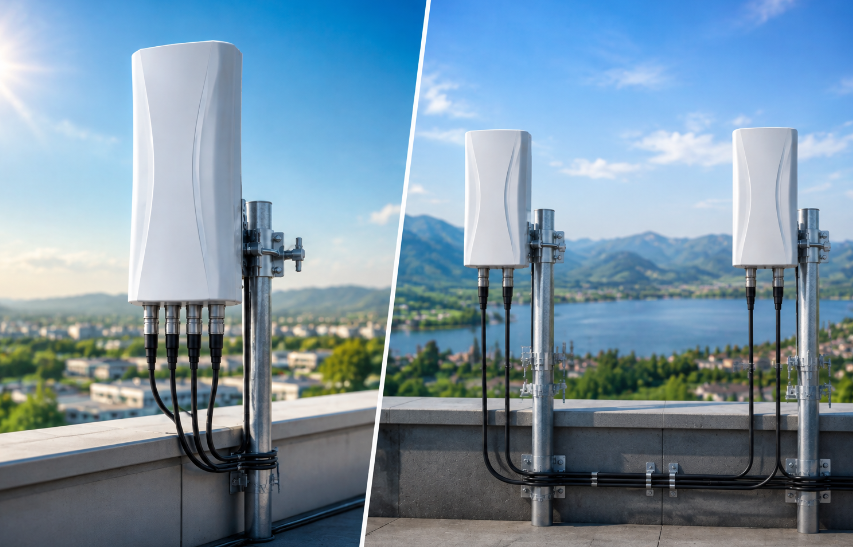
If a single integrated 4×4 MIMO antenna is unavailable or impractical for a specific installation site, connecting two separate 2×2 MIMO antennas to the router's four RF ports is a viable alternative to achieve full 4×4 MIMO performance. However, key technical differences exist between these two approaches.
Parameter | Integrated 1× 4×4 MIMO Antenna | Dual 2× 2×2 MIMO Antennas |
RF Channel Isolation | Guaranteed internally by factory engineering (no manual tuning required) | Depends strictly on physical separation distance during installation |
Installation Complexity | Low (Single mounting bracket, 1 radome enclosure) | Medium/High (Dual mounting brackets, precise spacing required) |
Deployment Flexibility | Fixed radiation pattern for all 4 streams | Allows cross-pointing (e.g., targeting two different cell towers) |
Overall Cost | Typically higher initial hardware cost | Lower hardware cost; utilizes readily available 2×2 stock |
· Integrated 4×4 Antenna (Like Buying a Pre-built PC): The manufacturer optimizes the placement of the four internal antennas for minimal interference before it leaves the factory. It delivers remarkably consistent speeds regardless of signal conditions.
· Dual 2×2 Antennas (Like Building a Custom PC): Performance relies entirely on the quality of installation. If the two antenna enclosures are mounted too close together (e.g., side-by-side), they will interfere with each other. The router detects the degraded signal quality and automatically throttles the connection, resulting in slower real-world speeds than the integrated unit.
· Dual 2×2 Antennas (Don't Put All Your Eggs in One Basket): Featuring two independent housings, you can mount one on the left and the other on the right (e.g., over 1 meter apart). If a metal sheet blocks the left side, the right antenna continues to receive signals, preventing an abrupt connection drop.
· Integrated 4×4 Antenna (All Eggs in One Basket): All four internal antennas reside in a single enclosure. If this specific spot gets blocked by a large metal barrier, all four channels collapse at once.
· Dual 2×2 Antennas: Requires running 4 RF cables from two different locations. If the cables vary in length or suffer from tight bends that cause signal loss, overall throughput will take a hit.
· Integrated 4×4 Antenna: Uses a single main cable that branches into 4 connectors with identical length and specifications, eliminating concerns over unbalanced line loss.
Only 2 ports → Choose 2×2 MIMO Antenna (Buying a 4×4 antenna is a waste of money because the extra ports are not available).
4 ports → Proceed to Step 2.
Remote rural areas / Low-speed backup / Budget-sensitive (Cell tower only broadcasts 2×2, speed requirement <50 Mbps) → Choose 2×2 MIMO Antenna.
5G networks / HD video streaming / Enterprise primary WAN / Weak signal areas (Speed requirement >100 Mbps) → Must choose 4×4 architecture, proceed to Step 3.
Standard mounting space / Want a plug-and-play solution → Integrated 4×4 Antenna (Factory-tuned, hassle-free installation).
Heavy metallic obstructions / Reusing existing 2×2 inventory → Dual 2×2 Antennas (Must be mounted at least 1 meter apart).
Need a reliable 2×2 or 4×4 MIMO antenna solution? Explore Asialeren’s complete MIMO antenna range for 4G LTE and 5G applications.
Explore MIMO antenna solutions →
Deploying a 4×4 MIMO antenna architecture generally requires a higher upfront hardware and cabling investment compared to a standard 2×2 setup. However, evaluating the total cost of ownership reveals that the higher initial expenditure often yields a significantly better long-term ROI in critical commercial and industrial applications.
Expense Item | 2×2 MIMO Setup | 4×4 MIMO Setup |
Antenna Hardware Cost | Baseline (1.0x) | Higher (1.5x – 2.0x) |
Cabling & RF Connectors | 2 Cables / Ports | 4 Cables / Ports |
Installation Labor | Standard | Standard (Integrated) / Higher (Dual 2×2) |
When 4×4 MIMO Justifies the Cost
· Protecting Hardware Investments (Future-Proofing): Modern 5G and LTE Cat 16+ enterprise routers account for a major portion of equipment budgets. Pairing a high-end router supporting multiple spatial streams with only a 2×2 antenna restricts the system by physical antenna channel limits, preventing it from triggering the router's full spatial multiplexing capabilities and underutilizing its performance potential.
· Mitigating Costly Operational Downtime: In industrial automation, digital signage, and mobile fleet connectivity, a dropped connection translates may lead to lost revenue or service-level agreement (SLA) penalties. The inherent ~3 dB signal processing gain and spatial redundancy of 4×4 MIMO significantly reduce connection drops in fringe coverage areas.
· Reducing Site Visits (Truck Rolls): Deploying a 2×2 antenna in a marginal coverage zone often leads to post-installation support tickets, requiring field technicians to revisit sites for troubleshooting or upgrades. Paying slightly more upfront for a 4×4 antenna prevents far more expensive field labor costs later.
Choose 2×2 MIMO for mass IoT deployments, low-bandwidth telemetry, or secondary failover links where strict budget caps outweigh maximum speed requirements.
Invest in 4×4 MIMO for primary enterprise WAN, 5G FWA, HD video transmission, and mission-critical operations. The ~1.5x increase in antenna hardware cost is quickly amortized by doubled network capacity, higher reliability, and longer operational lifespan.
No. Even with 2×2 client devices, a 4×4 antenna uses receiver diversity and beamforming to deliver an extra ~3 dB signal gain. This significantly improves actual throughput and link stability at medium-to-long ranges or through wall obstructions.
It depends on signal quality. In weak-signal or cell-edge areas (rural locations, dense foliage obstructions), it offers high ROI with substantial improvements in both download and upload speeds. However, if your signal is already strong, the primary bottleneck is cell tower bandwidth congestion, yielding minimal gains from an antenna upgrade.
Cabling complexity and thermal output. Running four individual RF cables (or one thick multi-core cable) requires larger wall penetrations and tougher cable routing. Additionally, 4×4 RF front-ends draw more power and generate noticeably higher heat, demanding better thermal management in enclosures.
Asialeren provides a complete range of 4G LTE and 5G MIMO antenna solutions, including 2×2 and 4×4 MIMO antennas with optimized isolation, low ECC, wide frequency coverage, and multiple installation options for industrial, commercial, and outdoor wireless applications.
Explore Asialeren’s MIMO Antenna Solutions →


 External GPS Antenna
  Ceramic antenna
  Internal GPS Antenna
  Surveying Antenna
 Magnet Antenna
  Patch Antenna
  Rubber Antenna
  Screw Antenna
  Spring Antenna
  Other Indoor Coverage Antenna&outdoor Wlan Antenna
 2.4G Antenna
  5.8G Antenna

 Outdoor Yagi TV Antenna


 Ceiling mount antenna
  Wall mount panel antenna
 Fiberglass Antenna
  Panel Antenna
  Parabolic Antenna
  Yagi Antenna


