

Views: 0 Author: Site Editor Publish Time: 2026-08-22 Origin: Site


The two most widely deployed LoRa frequency bands are 868 MHz and 915 MHz. The choice between them usually depends on the target deployment region: Europe commonly uses the EU868 band, while North America and Australia commonly use the US915/AU915 bands.
This guide breaks down the key differences between 868MHz and 915MHz LoRa frequency bands. We will cover regional regulations, antenna compatibility, and practical deployment considerations to help you choose the right frequency and build a reliable, compliant LoRa system for your application.
868 MHz and 915 MHz are sub-GHz radio bands used as physical carrier waves in LoRa technology to transmit small telemetry data (e.g., GPS, sensor readings) over long distances with minimal power.
They are defined by four core technical pillars:
Sub-GHz Wave Physics: With physical wavelengths of ~33–34 cm, these frequencies experience far lower path loss than 2.4 GHz Wi-Fi. This enables 5–15 km line-of-sight range and strong obstacle penetration through concrete and foliage.
Unlicensed ISM Spectrum: Both belong to public, license-free Industrial, Scientific, and Medical bands, eliminating cellular subscriptions or spectrum licensing fees.
Frequency Allocations: 868 MHz operates within 863–870 MHz, while 915 MHz spans a wider block from 902–928 MHz.
Regional Standardization: Managed locally to prevent interference, 868 MHz (EU868) is mandated across Europe, the Middle East, and Africa (ETSI), while 915 MHz (US915) covers the Americas and Australia (FCC/ACMA).
While both frequencies use LoRa modulation, local laws shape their performance, channel layouts, and real-world range.
Regional Bands & Regulatory Compliance
868 MHz (EU868): Governed by ETSI in Europe across a narrow 7 MHz band (863–870 MHz).
915 MHz (US915 / AU915): Governed by FCC/ACMA across a wide 26 MHz spectrum (902–928 MHz).
Cross-Use Warning: Using 915 MHz hardware in Europe (or vice versa) violates spectrum laws and risks interfering with public networks.
Channel Allocation: EU868 uses 8 primary 125 kHz channels. US915/AU915 features 64 uplink channels (125 kHz) + 8 downlink channels (500 kHz), often grouped into 8-channel Sub-bands (e.g., Sub-band 2) for standard gateways.
Airtime Enforcement:
868 MHz: Enforces a strict 1% Duty Cycle limit (max 36s of transmit time per hour), making it best for low-frequency telemetry.
915 MHz: Uses a 400 ms Dwell Time limit per packet alongside Frequency Hopping (FHSS), allowing more frequent transmissions without an hourly cap.
Transmit Power: EU868 is capped at +14 dBm (25 mW), whereas US915 allows up to +30 dBm (1 Watt) with FHSS—delivering 40 times higher transmit power.
Range & Penetration: Open-air propagation is nearly identical due to similar wavelengths (34.5 cm vs 32.8 cm). However, higher allowed power on 915 MHz gives it superior penetration through dense urban structures and tree canopies.
Battery Consumption: Transmitting at +14 dBm draws far less current (~120 mA) than full-power +30 dBm (~600 mA). Thus, 868 MHz nodes offer longer battery life, while 915 MHz setups trade energy efficiency for maximum signal reach.
No—standard single-band 868 MHz and 915 MHz antennas should not be swapped.
Although they look identical, they are tuned to different physical wavelengths. Using the wrong frequency antenna breaks impedance matching and triggers three direct hardware issues:
Signal Distance Drops (50–80% Loss): Because the antenna is off-frequency, up to 20%+ of your transmit power bounces back into the board instead of radiating into the air. Range drops immediately.
Overheating & Module Damage: Reflected power turns into heat inside the transceiver. Driving a 915 MHz module at full power (+30 dBm / 1 Watt) into an 868 MHz antenna can permanently burn out the transmitter chip.
Deaf Receiver: Impedance mismatch works both ways, making the antenna poor at picking up weak signals from distant nodes.
Dual-band antennas broaden their bandwidth to fit both frequencies, but they trade away peak efficiency and gain.
Desktop Testing: Dual-band antennas are fine for indoor development.
Field Deployment: Always use a dedicated, frequency-tuned single-band antenna for outdoor gateways, long-range nodes, and battery-powered setups.
Radio spectrum is governed by regional law. You cannot choose a frequency based on personal preference; you must use the band mandated for your deployment location.
• 868 MHz (EU868): Mandatory for Europe, Middle East, and Africa (EMEA). Covers 863–870 MHz.
• 915 MHz (US915 / AU915): Mandatory for North America, South America, Australia, and New Zealand. Covers 902–928 MHz.
• AS923 / IN865: Mandatory for parts of Asia (Japan, Taiwan, SE Asia) and India (865–867 MHz).
• Target Specs: Ensure the Voltage Standing Wave Ratio (VSWR) is ≤ 1.5 at your target frequency. This ensures over 96% of transmit power gets radiated into the air.
• Avoid Dual-Band Antennas: Universal 868/915 MHz antennas compromise internal tuning, often resulting in a VSWR above 2.0 and reflecting over 10% of your signal directly back into the board.
Antenna gain reshapes the RF signal beam—it concentrates energy in specific directions rather than creating extra output power.
• Low Gain (2–3 dBi | 60°–80° Vertical Beam):
Creates a spherical, donut-shaped signal pattern. Best for dense cities, indoor gateways, and hilly terrain where nodes are located at varying elevations or behind building obstacles.
• Medium Gain (5–6 dBi | 20°–30° Vertical Beam):
The sweet spot for suburban setups and general outdoor gateways, balancing horizontal range with elevation coverage.
• High Gain (8–12 dBi | 7°–10° Vertical Beam):
Creates a flat, laser-thin disc pattern. Best for flat open farmlands, desert telemetry, or rooftop point-to-point links. (Avoid using high gain in mountain areas, as the narrow beam will overshoot valley nodes.)
Form Factor Selection:
• Indoor / Mobile Nodes: Use flexible Rubber Duck or internal PCB/FPC patch antennas.
• Outdoor Gateways: Use heavy-duty, weatherproof Fiberglass antennas with IP67 sealing.
Coaxial Cable Selection & Signal Loss:
• Standard Thin Cables (RG58 / RG174): Lose 3–6 dB per 10 meters at 900 MHz. Only use these for short cable runs under 1 meter.
• Low-Loss Cables (LMR400): Lose less than 1.3 dB per 10 meters. Always use LMR400 for longer cable runs from a rooftop antenna to an indoor gateway.
Connector Type (SMA vs. RP-SMA):
• SMA: Features a center pin on the male connector. Standard for most LoRa hardware.
• RP-SMA: Features a center receptacle (hole) on the male connector. Common on Wi-Fi gear. Mixing SMA and RP-SMA results in zero physical contact, causing total signal failure.
Need a frequency-matched antenna for your LoRa project?
Asialeren provides 868MHz and 915MHz LoRa antennas with different gains, connectors, and designs for IoT devices and gateways.
End-Nodes (Sensors): Responsible only for collecting data and transmitting it over the air using low power (+14 dBm to +22 dBm).
Gateways: Responsible for listening 24/7 for over-the-air radio packets and forwarding them to the server via 4G or Ethernet.
915 MHz Required Configuration: The 915 MHz spectrum has 64 channels, but standard gateways can only listen to 8 at a time. Nodes must be locked in software to the corresponding sub-band (Sub-band 2 / Channels 8–15) of the gateway, otherwise most packets will not be received by the gateway.
868 MHz Duty Cycle Limit: European regulations restrict a single node's cumulative airtime to a maximum of 36 seconds per hour (1% duty cycle). Adaptive Data Rate (ADR) must be enabled to compress airtime.
Antenna Elevation: Elevating the gateway antenna from ground level to an open rooftop location directly doubles the communication range.
Cable Loss: Coaxial cables absorb RF signal. Standard thin RG58 cable loses 3–5 dB per 10 meters at 900 MHz; outdoor cable runs exceeding 2 meters must use LMR400 low-loss cable (less than 1.3 dB loss per 10m).
Outdoor Lightning Protection: Outdoor fiberglass antennas easily attract lightning strikes. The coaxial line must be wired through an in-line RF lightning arrestor connected to ground before entering the indoor enclosure.
RSSI (Received Signal Strength Indicator): -30 to -100 dBm indicates a strong signal; values near -120 dBm represent the sensitivity limit.
SNR (Signal-to-Noise Ratio): Measures signal clarity. LoRa allows demodulation under negative SNR values (such as -5 to -20 dB), but positive values represent a more stable connection.
Field Range Testing: Before permanently mounting hardware, perform a field survey with a GPS-enabled mobile node along the target area to map out RSSI/SNR dead zones.
Technically it will connect physically, but it is not recommended. An unmatched antenna raises the Voltage Standing Wave Ratio (VSWR > 2.0), causing over 10% of the transmit power to reflect back into the circuit. This reduces your communication range and can overheat the transceiver’s RF front-end.
In North America (US915), the spectrum is split into 64 channels across 8 sub-bands (FSB1 to FSB8). Standard 8-channel gateways only listen to one sub-band at a time (usually Sub-band 2 / Channels 8–15). If your node firmware is transmitting on a different sub-band, the gateway will miss all incoming packets. Ensure both node and gateway are locked to the exact same sub-band.
Yes, this is completely normal for LoRa technology. Due to Chirp Spread Spectrum (CSS) modulation, LoRa can demodulate signals received below the RF noise floor (typically down to -15 dB or -20 dB SNR). As long as your RSSI stays above the sensitivity limit (around -120 dBm), a negative SNR still provides a stable connection.
EU868 regulations enforce a strict 1% Duty Cycle limit, meaning a node cannot transmit for more than 36 seconds per hour. If you program a node to transmit every few seconds during testing, the regional LoRaWAN stack will automatically throttle transmissions and drop packets to remain legally compliant. Increase the interval between transmissions or enable Adaptive Data Rate (ADR).
Asialeren provides 868MHz and 915MHz LoRa antennas with multiple gains, connectors, and designs for IoT nodes and outdoor gateways.


 External GPS Antenna
  Ceramic antenna
  Internal GPS Antenna
  Surveying Antenna
 Magnet Antenna
  Patch Antenna
  Rubber Antenna
  Screw Antenna
  Spring Antenna
  Other Indoor Coverage Antenna&outdoor Wlan Antenna
 2.4G Antenna
  5.8G Antenna

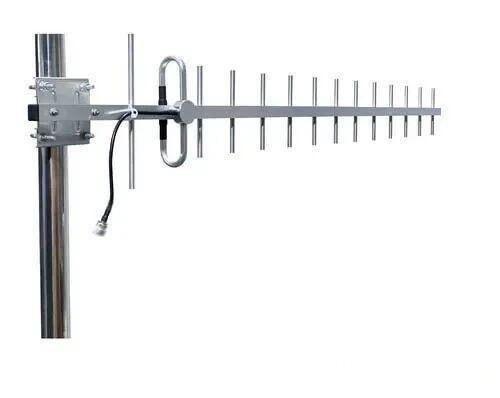 Outdoor Yagi TV Antenna


 Ceiling mount antenna
  Wall mount panel antenna
 Fiberglass Antenna
  Panel Antenna
  Parabolic Antenna
  Yagi Antenna


