

Views: 0 Author: Site Editor Publish Time: 2026-08-11 Origin: Site


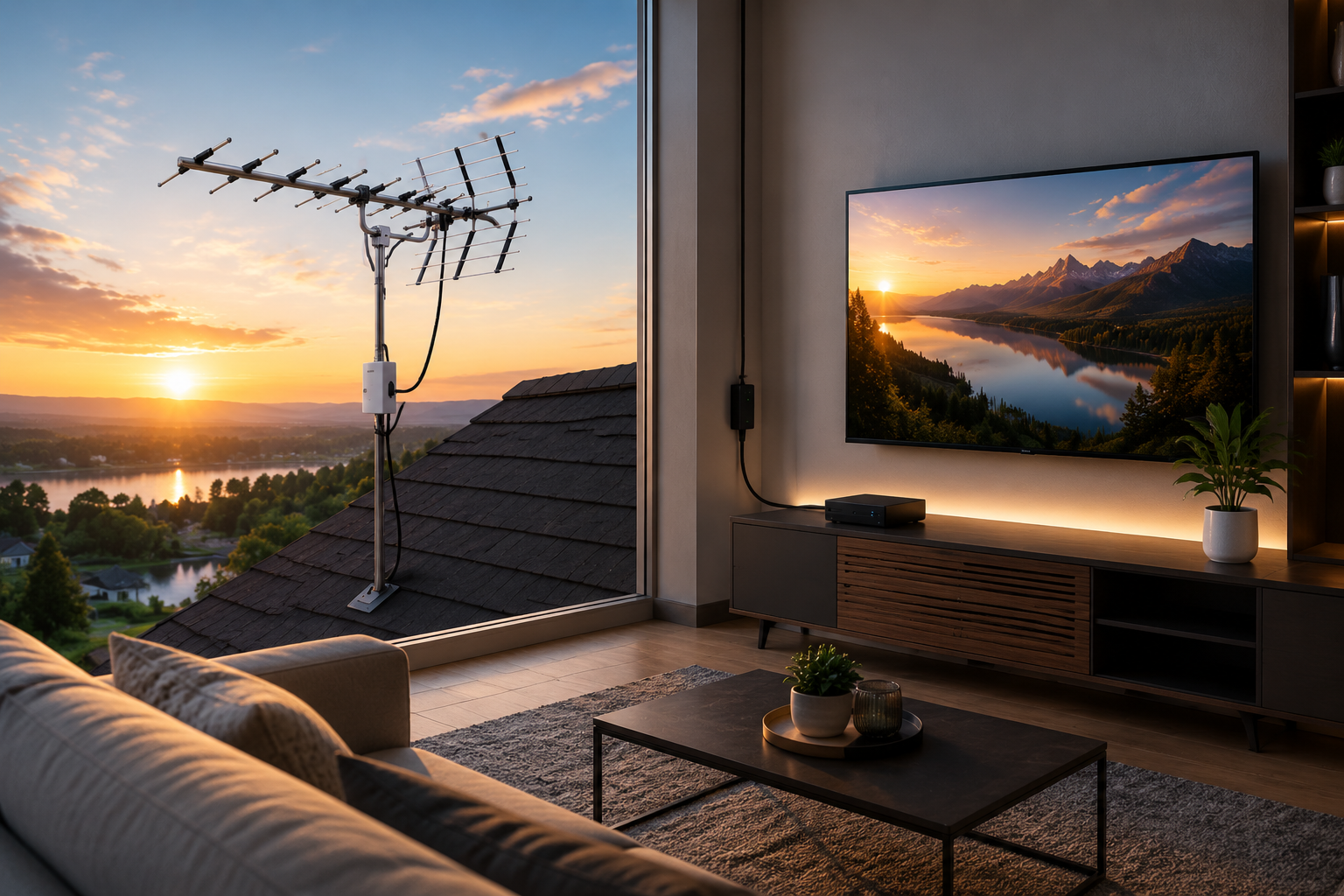
When dealing with weak reception, picking up a TV antenna amplifier seems like the obvious fix. But is it a genuine solution for stabilizing your channels, or an unnecessary expense that misses the mark? The answer isn't a simple yes or no. In fact, adding an amplifier under the wrong conditions can actually backfire, wiping out channels you currently receive.
How do antenna amplifiers actually work, and does your home setup truly warrant one? Before you spend money on extra hardware, this guide breaks down their actual capabilities, helps you diagnose your specific needs, and keeps you from falling into common reception pitfalls.
Yes, but they function strictly as power compensators rather than signal creators.
An amplifier cannot increase the antenna's physical gain or retrieve uncaptured broadcast channels. Its core function is to inject active power to offset predictable physical losses occurring after signal capture: standard RG6 coaxial cable degrades signal power by roughly 3 dB per 100 feet at UHF frequencies, while a basic 4-way passive splitter introduces a direct 7 dB insertion loss.
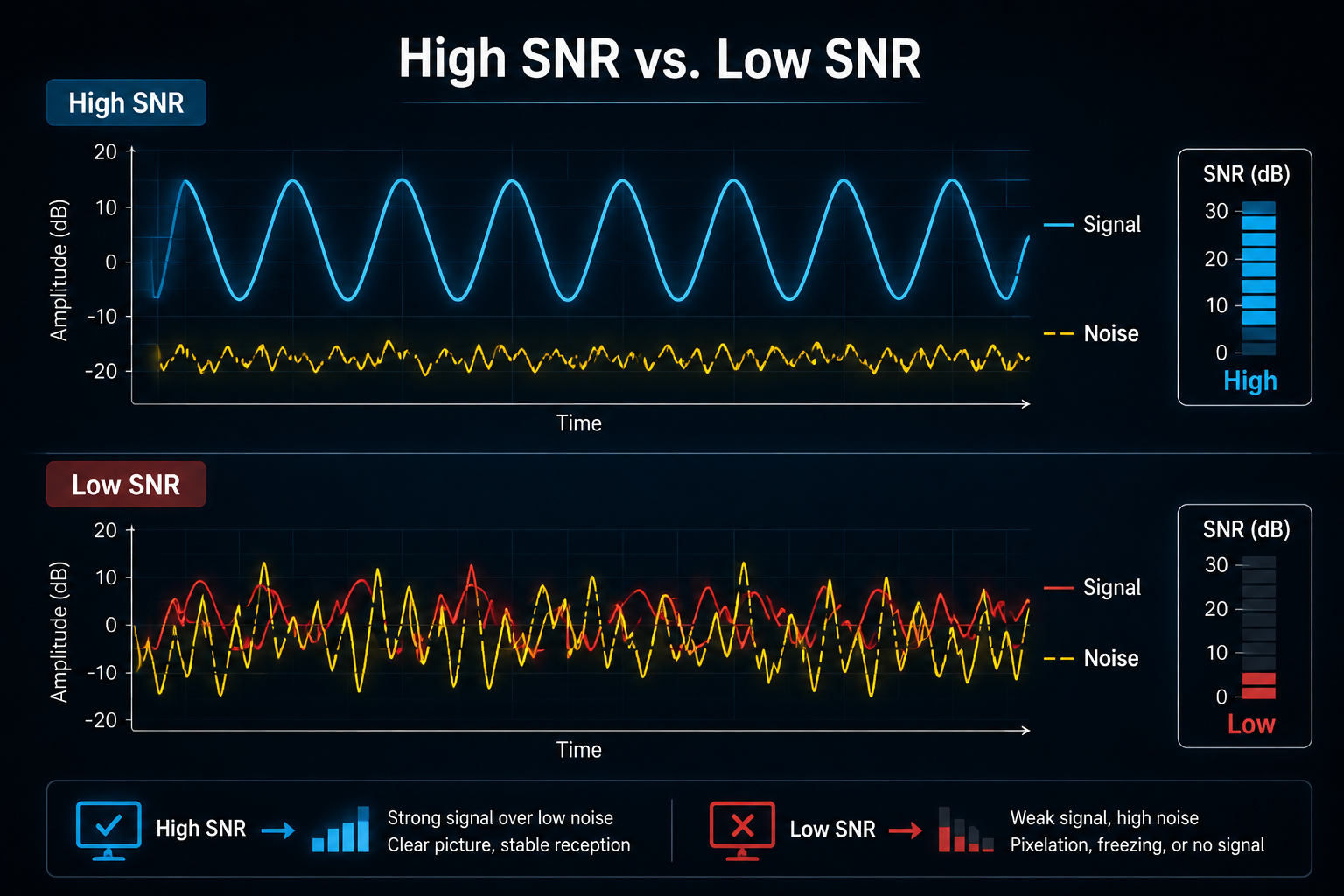
An amplifier prevents signal failure over long cable runs only when the antenna captures a sufficiently clear signal at the roof, specifically one that exceeds the 15 dB Signal-to-Noise Ratio (SNR) decoding threshold. Conversely, if the source signal is inherently corrupted by excess noise and falls below decoding standards, blindly adding an amplifier will not yield a single additional channel.
Most product listings and basic guides state that amplifiers "boost signal" to "fix pixelation." Technically, this is an oversimplification. To accurately determine whether an amplifier will benefit a specific setup, three fundamental technical principles must be evaluated:
Higher gain (dB) does not guarantee better reception for digital tuners operating in a fixed range. If incoming voltage exceeds the tuner's processing limit (e.g., via a 30 dB booster), the tuner saturates. Overloaded tuners generate spurious signals like intermodulation distortion and harmonics. This internal interference degrades or completely blocks reception for both strong local channels and weak distant ones.
Noise Figure (NF) is far more critical for signal clarity than advertised active gain (e.g., "20 dB Gain"). Active circuits naturally add internal circuit noise into the signal path. The NF specification measures how much extra noise the amplifier itself adds to the signal. High-performance amplifiers keep NF below 2 dB, while low-cost models average 5 dB to 7 dB. High-NF boosters add enough noise to bury weak signals, preventing decoding.
An antenna amplifier is a wideband booster that indiscriminately amplifies all incoming signals and background noise (EMI/RFI from electronics, LTE/5G, or FM). Tuners require adequate Signal-to-Noise Ratio (SNR) to decode data, not just higher power. Boosting a 30 dB signal over a 28 dB noise floor (2 dB SNR) with a 20 dB amplifier yields a 50 dB signal and 48 dB noise floor. The SNR remains unchanged at 2 dB, leaving the tuner unable to decode the signal.
You should use a TV antenna amplifier when your setup suffers from signal attenuation along the transmission path rather than weak reception at the antenna itself. An amplifier is justified under the following specific hardware configurations:
· Long Coaxial Cable Runs: If the distance between your antenna and the TV exceeds 50 feet (roughly 15 meters), line resistance causes noticeable signal degradation. An amplifier offsets this loss before the signal reaches the tuner.
· Multiple TV Connections (Splitter Loss): If a single antenna feeds two or more TVs through a passive splitter, each split divides the signal power. A distribution amplifier compensates for the insertion loss introduced by 2-way, 4-way, or 8-way splitters.
· Edge-of-Coverage Reception: If you live in a fringe signal area where broadcasts are weak but clean (unobstructed by nearby terrain or tall buildings), a low-noise masthead preamplifier mounted directly at the antenna can lift the signal above the TV's internal tuner threshold.
When NOT to use one: Do not install an amplifier if your cable run is under 20 feet to a single TV, or if you live within 15 miles of broadcast towers. In these scenarios, amplification will likely overload your TV's digital tuner, causing severe signal distortion and channel loss.
Move the TV as close as possible to the antenna (or use a short coaxial cable), bypass all splitters, wall outlets, and extension cables, and connect a single TV directly to the antenna. Then run a channel scan again.
Situation A: The TV receives multiple clear channels when directly connected to the antenna, but loses channels, freezes, or shows pixelation after returning to the original setup.
Diagnosis: The antenna itself is receiving a good-quality signal, but signal loss occurs during transmission. In this case, an amplifier can be considered to compensate for cable loss and splitter loss.
Situation B: Even with a short cable directly connected to the antenna, the TV still cannot receive channels reliably or experiences severe picture problems.
Diagnosis: The problem is more likely related to antenna placement, direction, installation height, or the original signal quality. In this situation, do not prioritize buying an amplifier. Instead, optimize the antenna installation or consider upgrading to a higher-gain antenna.
Based on the installation location and the type of signal loss being compensated for, TV antenna amplifiers can be divided into two main categories:
· Preamplifier / Masthead Amplifier:
Installation Location: Installed directly on the antenna mast (within 1 meter of the antenna feed point), before the main transmission cable.
Primary Function: Boosts weak signals at the source before they travel through a long coaxial cable. By adding gain at the cleanest point of the signal path, it can effectively compensate for transmission losses caused by cable runs longer than 15 meters.
Best Applications: Suitable for rural or suburban areas, fringe reception locations, and situations where the original signal is weak and the cable distance is long.
· Distribution Amplifier / Drop Amplifier:
Installation Location: Installed indoors, usually before a multi-way splitter (typically inside a home wiring box or at the main connection point).
Primary Function: Designed specifically to compensate for the insertion loss caused when a single antenna signal is distributed to multiple rooms. For example, a 4-way splitter can introduce around 7dB of signal loss, significantly reducing the signal level.
Best Applications: Suitable for homes where one outdoor or attic antenna needs to provide signals to three or more TVs simultaneously.
Key Selection Rule:
If the problem is a long cable run to a single TV, choose a preamplifier. If the problem is distributing one antenna signal to multiple TVs, choose a distribution amplifier. Avoid using both types in the same signal path unless you are dealing with extremely weak signals in very remote areas, as excessive amplification can easily overload the TV tuner and cause pixelation or channel loss.
For weak-signal areas, Asialeren’s high-gain outdoor TV antennas provide enhanced reception performance and can be paired with antenna amplifiers to build a more reliable TV reception system.
Follow these sequential steps to choose, position, and safely power your amplifier without causing signal distortion or tuner overload:
Choose by Setup: Use a Preamplifier for long cable runs to a single TV; use a Distribution Amplifier when splitting signals to 3+ TVs.
Gain Requirement: Aim for 15–20 dB of Gain for typical residential setups. Avoid excessive gain (>25 dB) unless you are in a deep-fringe rural area, as over-amplification will crush your tuner.
Noise & Interference: Choose a unit with a low Noise Figure (NF) under 2 dB and a built-in LTE/5G filter.
Note: Amplifiers only work if your antenna already captures an uncorrupted signal with an adequate Signal-to-Noise Ratio (SNR > 15 dB). They preserve SNR over long runs; they cannot fix a noisy source signal.
Preamplifier: Install directly on the antenna mast (within 3 feet of the antenna). This boosts the clean SNR before cable attenuation occurs.
Distribution Amplifier: Install indoors at the central junction, immediately before the passive splitter.
Connect the coaxial cable coming from the outdoor antenna/preamp to the Antenna / In port on the power inserter.
Use a short coaxial cable to connect the TV / Out port on the power inserter to your TV’s antenna port.
Plug the power inserter’s AC adapter into a wall outlet to feed power up the coax cable.
Run a full Auto-Scan / Channel Tuning on your TV menu.
Fine-Tuning Gain: If your amplifier features an adjustable gain dial, start at the lowest setting and gradually increase it until all desired channels clear up.
Overload Check: If channels completely black out or show "No Signal," your gain is too high and overloading the TV tuner. Turn down the gain or remove the amplifier.
Installing both a preamplifier and a distribution amplifier on the same coaxial cable line creates excessive signal gain. Unless you live in an extremely remote, deep-fringe area, stacking amplifiers will almost certainly overload your TV’s internal digital tuner, causing the screen to go black with a "No Signal" error. A single, correctly chosen amplifier is all that is needed for standard residential setups.
Modern 5G and LTE cellular towers operate on frequencies right next to over-the-air (OTA) television broadcast channels. Without a built-in LTE/5G filter, a high-gain TV amplifier will boost these strong mobile signals along with your TV broadcasts. This overpowers the amplifier circuit and interferes with digital decoding, leading to pixelation or missing channels. Make sure your amplifier includes an integrated LTE/5G filter.
Broadcast television operates across two primary frequency bands: VHF (Channels 2–13) and UHF (Channels 14–36). Many budget amplifiers do not deliver equal gain across both bands; they often heavily boost UHF while offering little gain—or even signal loss—for VHF frequencies. If your local stations broadcast on VHF channels, an incompatible amplifier can cause those specific channels to drop out entirely.
You should use a TV antenna amplifier when your setup has signal loss caused by:
· Long coaxial cables;
· Multiple TV splitters;
· Weak but clean antenna signals.
For most home installations, a 15–20 dBi TV antenna amplifier is usually sufficient. High-gain amplifiers above 25 dBi should only be used in extremely weak-signal areas, as excessive gain may cause tuner overload.
What noise figure (NF) should a TV antenna amplifier have?
A quality TV antenna amplifier should have a low noise figure, typically NF below 2 dB, to minimize additional noise during amplification and maintain better signal quality.
An LTE/5G filter is recommended in areas where nearby mobile networks may interfere with TV signals. The filter helps reduce unwanted cellular interference and improves reception stability.


 External GPS Antenna
  Ceramic antenna
  Internal GPS Antenna
  Surveying Antenna
 Magnet Antenna
  Patch Antenna
  Rubber Antenna
  Screw Antenna
  Spring Antenna
  Other Indoor Coverage Antenna&outdoor Wlan Antenna
 2.4G Antenna
  5.8G Antenna

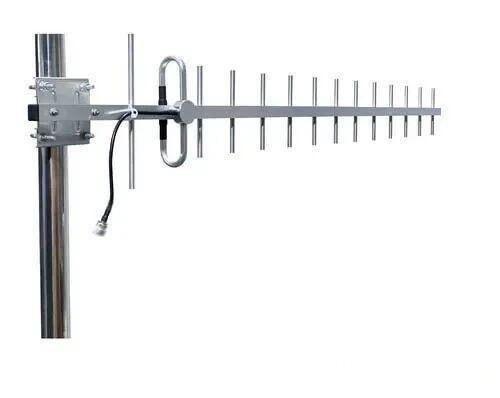 Outdoor Yagi TV Antenna


 Ceiling mount antenna
  Wall mount panel antenna
 Fiberglass Antenna
  Panel Antenna
  Parabolic Antenna
  Yagi Antenna


