

Views: 0 Author: Site Editor Publish Time: 2026-05-15 Origin: Site


Walking around the RF lab, it's almost impossible to avoid the same number: 50 ohms.
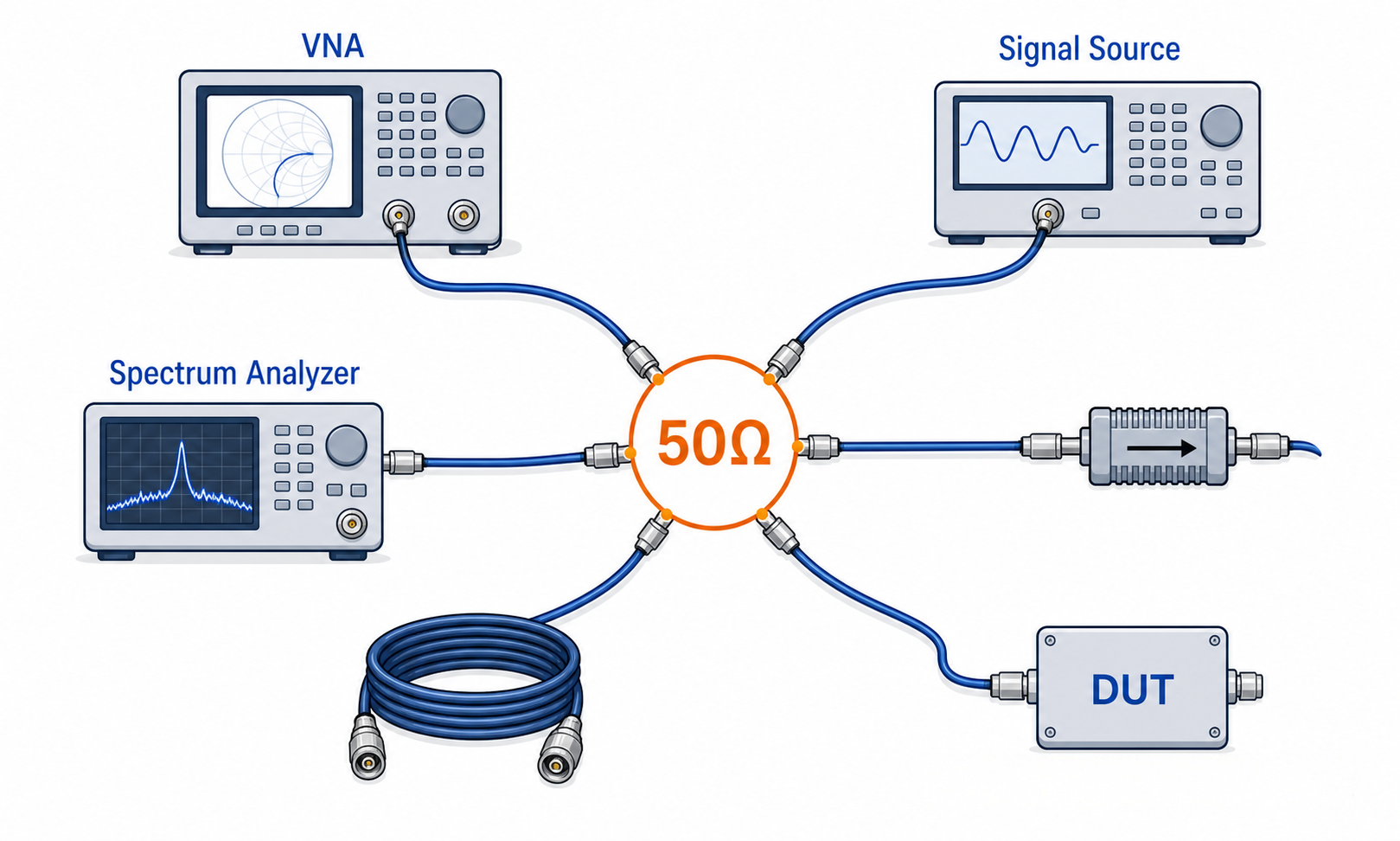
The vector network analyzer is marked with 50 ohms, the input port of the spectrum analyzer is marked with 50 ohms, and the output impedance of the signal source is written with 50 ohms. 50 ohms can be seen everywhere at the interface of coaxial cables, fixed attenuators, power dividers, and even a large number of radio frequency modules.
So a reasonable question naturally arises: "Why did you choose 50 ohms? Instead of 40 ohms, 60 ohms, or the equally rare 75 ohms?"
This question is by no means the historical custom of any one unit, nor the subjective decision of any one company. 50Ω is essentially a compromise between RF engineering's long-term trade-offs between power tolerance, transmission losses, manufacturing feasibility, and standardized interoperability. It is not the only correct value in the laws of physics, but it is undoubtedly one of the most important engineering conventions in the field of RF testing and communication equipment.
The true meaning of understanding 50 ohms is not to remember a historical conclusion, but to understand that as long as your system is built in accordance with 50 ohms, then instruments, cables, devices, test fixtures, and S-parameter data will communicate using the same set of engineering language.
What exactly is this metric describing?
In the context of an RF system, 50 ohms usually does not mean that "there is really a 50 ohms resistor installed inside that continues to consume power", but rather that the reference impedance of the system is agreed to be 50 ohms.
It answers a class of interface questions: what is the equivalent impedance it "wants" to see as an RF signal travels along a cable, connector, PCB trace or instrument port?
If the impedance encountered by the signal along the way is 50 ohms, the propagation process will be relatively smooth, and the reflection phenomenon will not be obvious. On the contrary, if a place suddenly becomes 20 ohms, 100 ohms, open circuit or short circuit, the signal will reflect, causing the S11 to deteriorate, the power transmission efficiency will decrease, and in severe cases, it will also induce standing waves, ripples and even system instability.
Therefore, the core meaning of 50Ω is not that "this number has mysterious properties", but that the entire RF link uses the same impedance reference, so that the power transmission, measurement readings and device specifications can be compatible with each other.
Why did this benchmark end up mainly at 50 ohms?
From the two extremes of the coaxial line, we can understand why.
The lower the impedance, the more conducive it is to withstand higher power. Low impedance means that it can carry more current at the same voltage, and its structure itself is more suitable for high-power transmission scenarios.
The higher the impedance, the lower the transmission loss may be under certain conditions. For air-medium coaxial lines, the minimum attenuation point occurs between 70 ohms and 80 ohms - which is one of the important reasons why 75 ohms systems are widely used in television, video, and broadcast reception links.
The 50Ω falls roughly between these two requirements: it has the right power capacity, achieves acceptable transmission losses, and is easy to process into a stable and reliable coaxial structure. This is why it has become the mainstream choice in RF testing, radar, communications, and microwave engineering.
What is the relationship between 50 ohms and the S-parameter?
The measurement and interpretation of the S-parameter must rely on a clear reference impedance.
In most RF instruments and datasheets, this reference impedance is precisely 50 ohms.
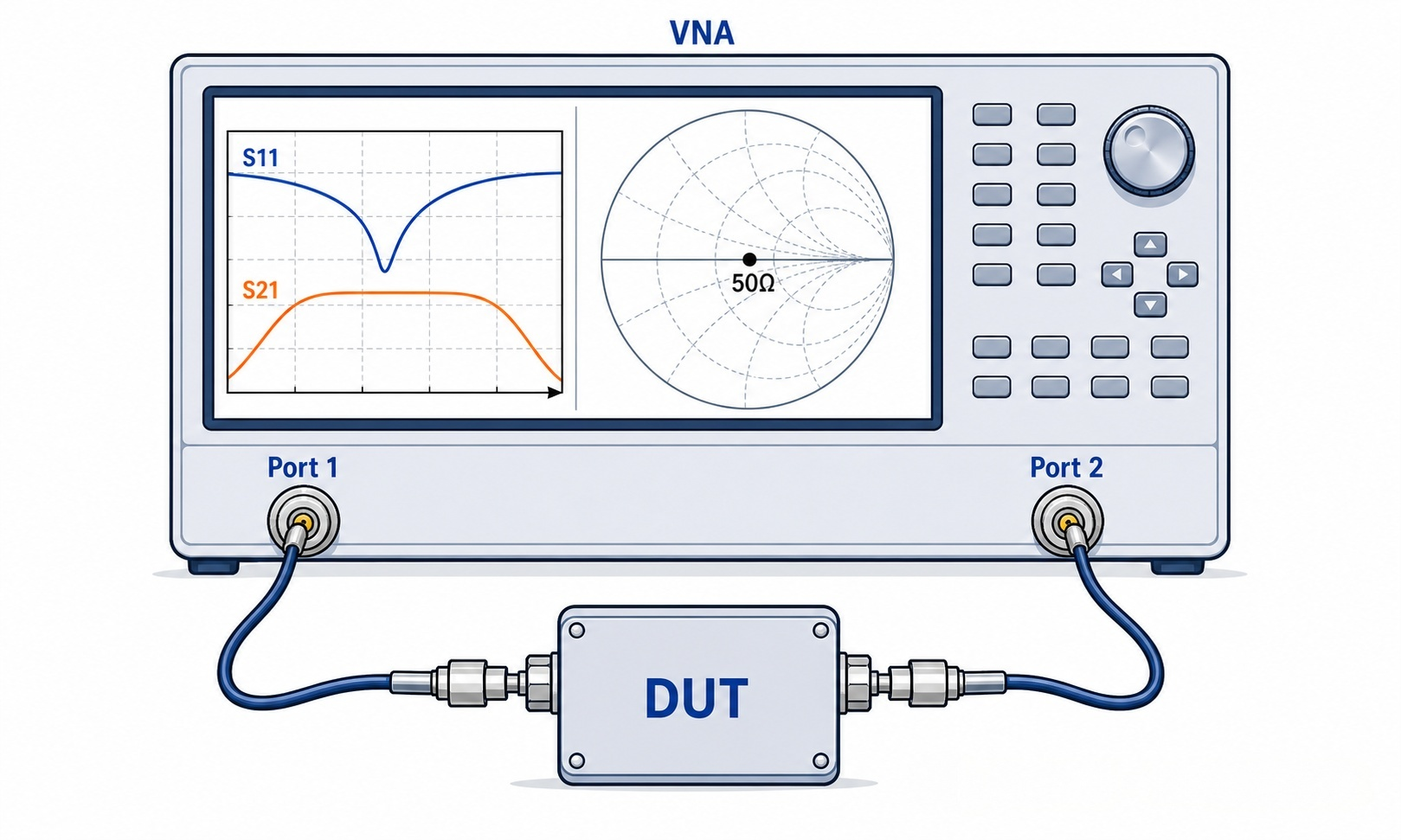
When you look at a device's S11 = -20 dB, the true meaning is not "the device is absolutely perfect", but rather: its input port is relatively small in reflection under a 50 Ω reference system.
Likewise, when you read that S21 = 12 dB, it usually means that the transfer gain from port 1 to port 2 is 12 dB under the conditions of 50 Ω source impedance and 50 Ω load impedance. The conditions of "50 Ω source" and "50 Ω load" are crucial - because if your actual system is not 50 Ω, the measured performance of the device is likely to deviate.
For example, an amplifier datasheet states:
Gain = 15 dB
Input Return Loss = 18 dB
Output Return Loss = 12 dB
Condition: 50 Ω system
This set of data makes it clear that this metric was obtained in a 50 Ω testing environment. If it is directly connected to a poorly matched antenna, filter or homemade fixture, the actual gain and stability will most likely not match the manual values. Conversely, if the entire link is maintained at 50 Ω, the S-parameter is highly engineering comparable - you can add up the cable loss, attenuator insertion loss, filter insertion loss, and amplifier gain step by step to complete the link budget.
This is precisely the true value of 50 ohms: it allows different modules in the RF world to be freely connected like building blocks, and allows measurements to have a uniform frame of reference.
How to interpret the correlation curve?
To determine whether a device is suitable for a 50-ohm system, it is usually necessary to pay attention to three types of curves.
1.observe S11 and S22.
S11 reflects the matching degree of the input port with respect to 50Ω, and S22 corresponds to the output port. Common engineering judgments are as follows:
indicator | meaning | Effect on 50 Ω systems |
S11 lower | Low input reflection | The signal source or front stage sees a load closer to 50 ohms. |
S22 lower | Low output reflection | The subsequent stage or load is easier to receive power |
S11/S22 is obviously high | Port deviation 50Ω | May introduce power errors, ripple, or stability issues |
2.pay attention to S21.
In a 50 Ω system, the S21 can be used directly for the link budget. For example:
Signal source output -10 dBm
Cable loss 1 dB
Filter insertion loss 2 dB
Amplifier gain 15 dB
Then the output power is -10 - 1 - 2 + 15 = 2 dBm.
The premise of this calculation is that the port matching of each stage is not seriously deviated. If the matching is poor, the reflection will affect the actual power transmission, and the simple dB addition will become unreliable.
3.look at the Smith chart
The center point of the Smith chart usually corresponds to 50 ohms. The closer the trajectory of the device port is to the center, the closer the impedance is to 50 ohms; if the trajectory is significantly off-center, the impedance changes sharply with frequency.
What information should a data manual focus on?
When consulting a data sheet, the most relevant content related to 50 ohms is often reflected in the test conditions.
●Test condition: 50 ohms. Typical indicators of most RF devices (amplifiers, filters, mixers, power dividers, couplers, attenuators, switches, etc.) are measured by default in a 50 ohms system, and the S-parameter curve is usually based on 50 ohms.
●Verify that the port has been internally matched. Some modules state Input/Output impedance: 50Ω, which means that the internal matching is done, and the external can be directly connected to the 50Ω system. However, some chips may be marked External matching required, which means that the chip pins themselves are not 50Ω, and need to be matched to 50Ω through external inductors, capacitors, microstrip lines or Barron networks.
●Pay attention to the operating frequency band. A device with a nominal 50Ω does not mean a good match from DC to infinite high frequencies. Data sheets generally give specific frequency bands (e.g. 700 MHz to 2700 MHz, or 2.4 GHz to 2.5 GHz). Beyond this band, S11, S21, phase, and stability can all change significantly.
●Pay attention to typical, min, max and test temperature. 50 Ω matching is also affected by process dispersion, temperature, bias and signal level. It is easy to make overly optimistic judgments based on typical curves alone. Worst case scenarios and design allowances should not be ignored when mass production or serious selection.
●Analyze the evaluation board schematics. Many RF chip datasheets provide EVB matching networks. If the chip itself is not 50 ohms, the inductance, capacitance, and wiring structures on the evaluation board are part of the system that converts it to 50 ohms. Directly copying the chip and ignoring the matching network often results in deviations from expectations.
Some common misconceptions
Myth 1:50 Ω is the best impedance 50 Ω is not the "optimal solution" in all scenarios, but a rather successful compromise and standard in RF engineering. TV/video systems are commonly 75 Ω, differential high-speed interfaces are often 90 Ω or 100 Ω, and the optimal impedance inside the antenna and chip may not be 50 Ω.
Myth 2: As long as the interface is 50 ohms, there will be no reflection. Nominal 50 ohms does not equal the actual perfect match. Connectors, adapters, pads, PCB traces, device packaging, and band edges all introduce impedance discontinuities.
Myth 3: Cables with the same 50 ohms can be interchanged at will. Even if they are all 50 ohms, different cables may vary greatly in terms of loss, phase stability, bending sensitivity, power capacity, and frequency limit. In high-frequency testing, it is not possible to choose a type based on "whether it is 50 ohms".
Myth 4:75Ω and 50Ω are not much different, and can be mixed in low-demand situations or temporarily available, but in accurate power testing, S-parameter measurement, and broadband links, the mixing of 50Ω and 75Ω will inevitably produce reflection and reading errors. When the mechanical size of the connector is similar, it is especially easy to misconnect.
Myth 5: Measuring 50Ω with a multimeter can determine that the RF matching multimeter measures low frequency or DC resistance, while the RF is concerned with the characteristic impedance and port impedance at high frequency. A 50Ω end point load can be checked with a multimeter, but PCB wiring, connector transition zone, device port matching, etc. cannot be judged by the multimeter alone.
Selection and testing recommendations
When selecting a device, confirm whether it is targeted at a 50 Ω system. For standard RF modules (filters, attenuators, power dividers, couplers, switches, etc.), devices that explicitly provide 50 Ω S parameters are preferred, and subsequent link budgeting, simulation, and testing will be smoother.
For chip-based devices, pay attention to whether external matching is required. For many LNA, PA, mixer, and RF transceiver chips, the best noise matching, best power matching, or best linearity matching is not directly equal to 50Ω. Refer to official design documents and matching networks when designing.
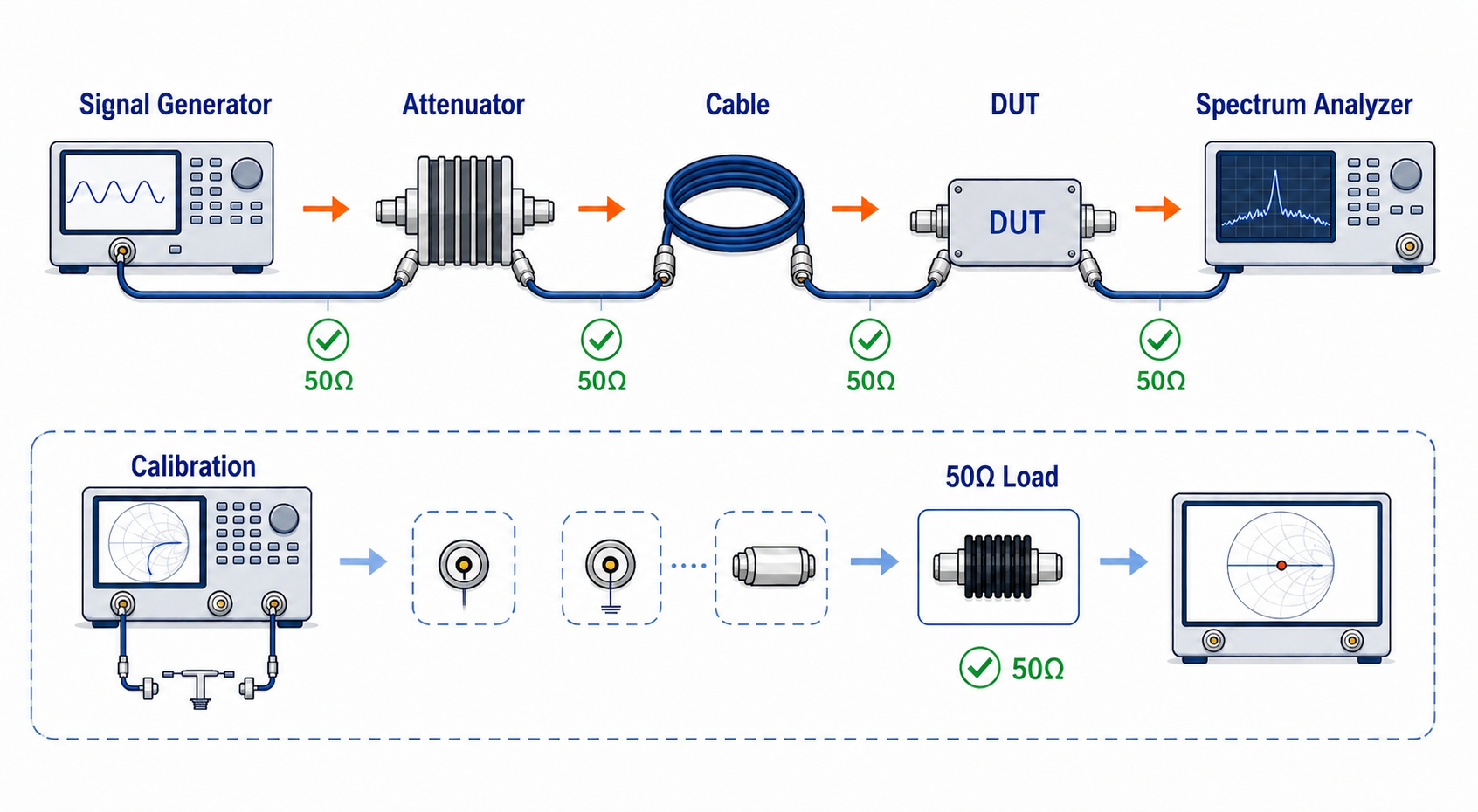
Verify the 50 Ω test link with standard parts before testing.
Common steps are as follows:
1.Calibrate the VNA.
2.Connect to 50Ω standard load;
3.Verify that S11 is sufficiently low (e.g. better than -35 dB).
4.Then connect the device under test (DUT). If the standard load measurement results are not satisfactory, do not rush to suspect the DUT.
In theory, dB can be added step by step, but the premise is that the matching of each level is good enough. If the S11 or S22 of a certain level is obviously high, there may be standing ripple in the link, resulting in fluctuations in frequency response and increased power uncertainty.
A practical criterion
50 ohms is the interface standard, not the end point of the design.
The ultimate goal is not to "make every internal node 50 ohms", but to enable the system to correctly connect with the 50 ohms world on the port where power needs to be exchanged and tested. There may be nodes that are not 50 ohms inside the chip, inside the matching network, and near the antenna feed point.
When you see 50Ω in the future, don't just think of it as a cold number, but realize that it is an engineering language.
You can make a quick judgment with the following questions:
●Are instruments, cables, connectors, and DUTs all designed for a 50-ohm system?
●Is the S-parameter in the data sheet based on the 50-ohm test condition?
●In the operating frequency band, is the S11/S22 ideal enough?
●Has the calibration plane been moved to the port of real concern?
●Is there a mix of 50Ω and 75Ω, single-ended and differential, chip bare port and module port?
If you have all these questions in mind, then the 50Ω will be your friend: it allows complex RF links to have a unified interface, instrument readings to be comparable, and a common benchmark for device selection and system debugging. Conversely, if these issues are not sorted out, the 50Ω is just a familiar number next to the port - it looks pleasing to the eye, but it is prone to problems when measured.
Professional Communication Products
ZHENGZHOU LEHENG ELECTRONIC TECHNOLOGY CO.,LTD
Tel:86-371-60911368
Email:info@global-antenna.com
Website:https://www.asialeren.com


 External GPS Antenna
  Ceramic antenna
  Internal GPS Antenna
  Surveying Antenna
 Magnet Antenna
  Patch Antenna
  Rubber Antenna
  Screw Antenna
  Spring Antenna
  Other Indoor Coverage Antenna&outdoor Wlan Antenna
 2.4G Antenna
  5.8G Antenna

 Outdoor Yagi TV Antenna


 Ceiling mount antenna
  Wall mount panel antenna
 Fiberglass Antenna
  Panel Antenna
  Parabolic Antenna
  Yagi Antenna


