 English
Views: 0 Author: Site Editor Publish Time: 2025-12-14 Origin: Site

Choosing the right directional antenna can make or break a wireless link. When users compare a Yagi antenna and a Parabolic Antenna, they usually want one clear answer: which one works better for my situation? In reality, both designs serve different purposes. They solve different problems in outdoor wireless communication, TV reception, amateur radio, and outdoor WLAN antenna systems.
A Yagi antenna focuses signals efficiently without complex installation. A parabolic antenna pushes range and signal purity to the limit, but demands precision. Understanding how they differ in gain, beamwidth, frequency behavior, cost, and installation helps avoid wasted budget and unstable links. This guide explains those differences in plain language, so anyone can choose with confidence.
A Yagi antenna is a directional antenna made from several metal elements arranged in a straight line along a single boom. Its structure allows radio energy to be concentrated in one main direction, which improves signal strength and reduces unwanted interference compared with omnidirectional antennas.
A Yagi antenna typically includes one driven element connected to the signal source, a reflector positioned behind it, and one or more directors placed in front. These elements interact with each other to shape the radiation pattern. The driven element generates electromagnetic waves, the reflector pushes energy forward, and the directors guide and focus the signal by re-radiating energy at slightly different phases. This phased interaction strengthens radiation in the forward direction while suppressing it elsewhere.
Yagi antennas generally operate between 30 MHz and 3 GHz, covering the VHF, UHF, and lower microwave bands. This range makes them suitable for many outdoor WLAN antenna installations, television reception, and terrestrial wireless communication systems. They offer high gain for their size, a narrow beamwidth, and reliable directional performance.
The simple mechanical design of a Yagi antenna keeps it lightweight, affordable, and easy to install. It delivers strong performance in fixed installations and requires little maintenance. However, bandwidth is somewhat limited, higher-gain designs need a longer boom, and signal quality can decline if alignment changes. For these reasons, Yagi antennas are most commonly used in stable setups such as TV reception, amateur radio, point-to-point wireless links, and long-range communication in rural areas.
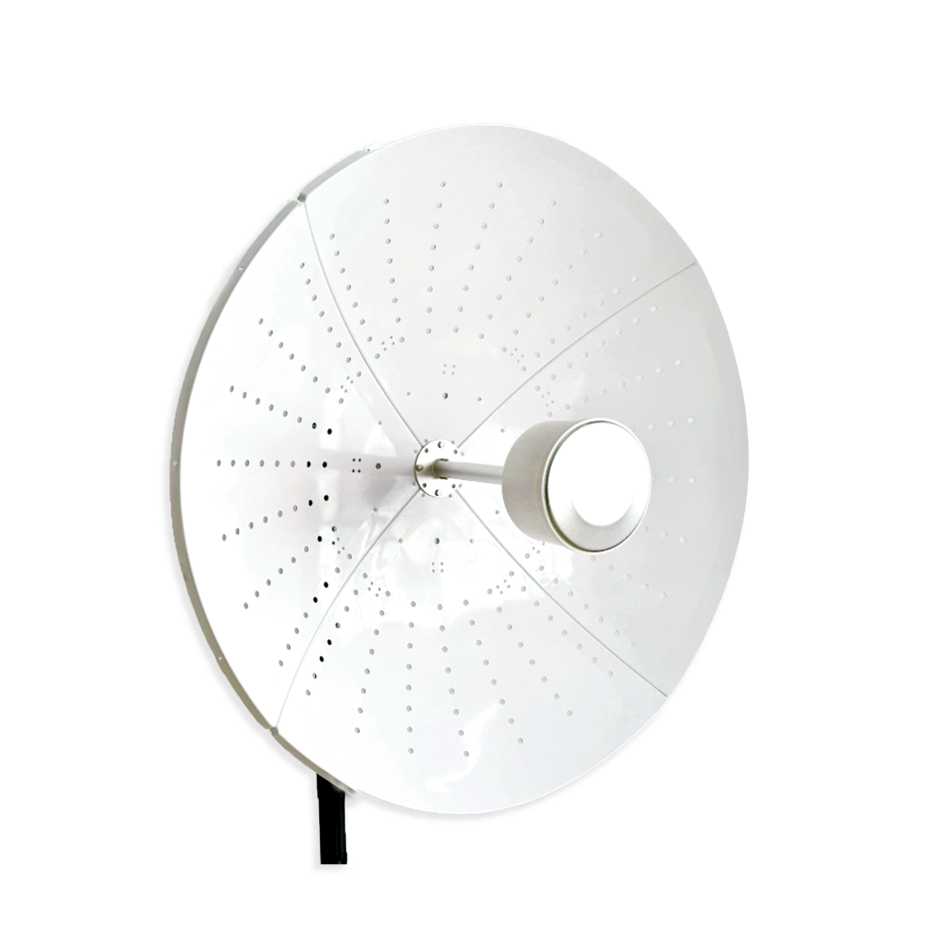
A parabolic antenna, often called a dish antenna, uses a curved reflective surface to focus radio waves onto a single point. This design allows it to collect and concentrate very weak signals, which makes it ideal for long-distance and high-frequency communication.
A parabolic antenna consists of a parabolic reflector, a feed antenna placed at the focal point, and a mounting system that supports precise alignment. Incoming radio waves strike the curved surface and reflect toward the focal point. The feed antenna captures this concentrated energy and converts it into an electrical signal. This geometric focusing effect is what gives a parabolic antenna its extremely high gain and sharp directionality.
Parabolic antennas usually operate at UHF and microwave frequencies, most commonly above 1 GHz. At higher frequencies, wavelengths become shorter, which allows the dish to achieve much higher gain with a relatively compact size. This makes parabolic antennas especially effective for outdoor WLAN antenna links, microwave transmission, and satellite communication.
The primary advantage of a parabolic antenna is its very high gain combined with an ultra-narrow beamwidth. It rejects off-axis interference extremely well and performs reliably when signals are weak or travel over long distances. However, these benefits come with trade-offs. Parabolic antennas are larger and heavier than Yagi designs, require very accurate alignment, and involve higher installation and mounting costs. They are also more sensitive to wind load and vibration.
Because of these characteristics, parabolic antennas are widely used in satellite communication systems, wireless backhaul links, radar applications, and radio astronomy, where maximum signal strength and precision matter.
| Antenna Type | Typical Gain |
|---|---|
| Yagi Antenna | 7–14 dBi |
| Parabolic Antenna (Dish) | 20–35+ dBi |
Gain directly affects how far a signal can travel.
A parabolic antenna concentrates energy into an extremely tight beam, which allows it to reach very long distances with minimal signal loss. This makes it a strong choice for satellite links and long-distance Outdoor WLAN antenna backhaul connections.
A Yagi antenna, while offering lower gain, still delivers solid long-range performance. It works well for point-to-point wireless links, rural internet access, and TV or radio reception where extreme distance is not required. In many outdoor WLAN installations, a Yagi antenna provides enough gain without the complexity of a large dish.
| Feature | Yagi Antenna | Parabolic Antenna |
|---|---|---|
| Beamwidth | Narrow | Ultra-narrow |
| Alignment Sensitivity | Medium | Very high |
| Side Lobe Control | Moderate | Excellent |
Beamwidth determines how precisely an antenna must be aimed.
A parabolic antenna produces an ultra-narrow beam, which improves signal quality but requires very accurate alignment. Even small positioning errors can reduce performance, especially in outdoor WLAN antenna systems operating at higher frequencies.
A Yagi antenna offers a narrower beam than omnidirectional antennas, yet it remains more forgiving during installation. This flexibility makes Yagi antennas easier to deploy on rooftops, towers, or temporary outdoor setups.
Yagi antennas support wider bandwidth ranges
Parabolic antennas operate best within narrow frequency bands
A Yagi antenna can maintain stable performance across a broader range of frequencies. This characteristic is helpful in environments where signal conditions change or when frequency agility is required in outdoor WLAN antenna applications.
A parabolic antenna is optimized for specific frequencies. Its design favors efficiency over flexibility, which works well for fixed-frequency microwave and satellite communication links but offers less tolerance for frequency variation.
Interference can degrade wireless performance, especially in dense areas.
A Yagi antenna may receive some unwanted signals from the sides, particularly in crowded RF environments. However, careful positioning often minimizes this effect in rural or suburban outdoor WLAN antenna deployments.
A parabolic antenna excels at interference rejection. Its focused radiation pattern reduces off-axis noise, improving signal clarity. This advantage makes parabolic antennas suitable for urban environments and high-capacity wireless backhaul systems where interference control is critical.
| Factor | Yagi Antenna | Parabolic Antenna |
|---|---|---|
| Weight | Light | Heavy |
| Mounting | Simple | Reinforced |
| Setup Time | Short | Long |
| Portability | Moderate | Low |
Installation effort differs significantly between the two.
A Yagi antenna is lightweight and easy to mount using standard brackets. This makes it ideal for quick outdoor WLAN antenna installations, temporary links, or locations with limited structural support.
A parabolic antenna requires stronger mounting hardware and careful alignment. Its larger surface area increases wind load, which must be considered during installation. These antennas are best suited for permanent outdoor installations where stability and precision are priorities.
Yagi antennas have lower initial cost
Installation is simple and affordable
Maintenance requirements remain minimal
A Yagi antenna offers excellent value for cost-sensitive projects. It delivers reliable outdoor WLAN performance without expensive mounting systems or specialized tools.
A parabolic antenna involves higher upfront investment. Equipment cost, reinforced mounts, and professional alignment increase total ownership cost. However, this expense is justified in applications demanding maximum range and signal purity.
The better antenna for long-range communication depends mainly on distance, frequency, and deployment conditions.
A Yagi antenna performs well at medium distances, especially at VHF and UHF frequencies. It offers focused directivity without excessive complexity, making it suitable for many outdoor WLAN antenna installations where coverage needs to be stable but not extreme.
A parabolic antenna becomes the better option when communication spans very long distances or operates at microwave frequencies. Its ability to concentrate energy into a tight beam allows signals to travel farther with less loss. In high-capacity outdoor WLAN backhaul links, parabolic antennas provide the precision and gain required for reliable performance.
Both antenna types deliver excellent results when matched correctly to the application and environment.
For television and radio reception, a Yagi antenna is usually the better choice. It efficiently handles VHF and UHF signals and provides enough gain to receive distant broadcast stations. Its narrow beam helps reduce interference while remaining easy to install on rooftops or outdoor masts.
Wireless internet links vary widely in distance and frequency. For short to medium point-to-point connections, a Yagi antenna often meets performance needs while keeping installation simple and cost-effective. For long-distance outdoor WLAN antenna backhaul links, a parabolic antenna offers higher gain and better signal stability, especially in congested radio environments.
Amateur radio operators frequently choose Yagi antennas because they offer a strong balance between gain, affordability, and directional control. They support multiple frequency bands and remain practical for fixed stations and portable field operations alike.
Satellite communication relies almost entirely on parabolic antennas. The high gain and narrow beamwidth allow precise alignment with orbiting satellites. Without this level of focus, stable satellite links would be difficult to maintain, especially over long distances.
In industrial and commercial networks, antenna choice depends on permanence and scale. Fixed infrastructure installations often use parabolic antennas for maximum reliability and long-range outdoor WLAN connectivity. Temporary sites, backup links, or mobile deployments typically favor Yagi antennas due to easier handling and faster installation.
Environmental conditions play a major role in antenna performance.
A parabolic antenna presents a larger surface area, which increases wind load and mounting requirements. Strong winds or severe weather can affect alignment if the mounting structure is not sufficiently reinforced.
A Yagi antenna handles harsh outdoor conditions more easily due to its lighter weight and open structure. Both antenna types require clear line-of-sight to perform well, especially in outdoor WLAN antenna installations. Stable mounting, proper grounding, and correct orientation remain essential regardless of the antenna selected.
Terrain, climate, and available mounting space should always be evaluated before making a final decision.
Ask these questions before buying:
What frequency will I use?
How far is the signal source?
Do I need extreme gain?
Is portability important?
What mounting space is available?
Choosing the right antenna means balancing performance, installation effort, and long-term reliability. A Yagi antenna often delivers enough gain for most outdoor WLAN and long-range communication needs without complicated setup, while a parabolic antenna excels when distance and precision matter most.
High gain adds complexity. Simplicity often improves reliability. The best antenna is not the most powerful one, but the one that fits your environment, frequency, and real-world usage conditions.
A: Neither is universally better; a Yagi antenna suits medium-range links, while a parabolic antenna excels at very long distances.
A: Yes, a Yagi antenna works well for outdoor WLAN antenna setups that need moderate gain and simple installation.
A: Choose a parabolic antenna when the link distance is long, frequencies are high, and interference rejection is critical.
A: A Yagi antenna generally handles wind better due to its lighter structure and lower wind load.
There is no single “best” antenna for every scenario.
A Yagi antenna suits medium-range links, VHF and UHF use, and outdoor WLAN antenna systems where simplicity, flexibility, and cost control matter. It delivers stable directional performance without complex mounting or precise alignment.
A Parabolic Antenna excels when long distance, higher frequencies, and strong interference rejection are critical. It is ideal for satellite communication, wireless backhaul, and high-capacity outdoor WLAN links, provided installation conditions support accurate alignment.
The right choice depends on real-world conditions rather than gain alone. Terrain, wind load, available space, and frequency stability often influence performance more than specifications. For dependable antenna solutions, Zhengzhou LEHENG Electronic Technology Co., Ltd. offers a full range of Yagi antennas, parabolic antennas, and outdoor WLAN antenna products designed for reliable operation in demanding environments.


