


GL-BA700
GLOBAL
8517710000
10pc
Accepted
1000PC/Day
| Quantity: | |
|---|---|
| PDF Export | |


Frequency Range (MHz) | BDS:B1,B2,B3 GPS: L1, L2,L5 GNONASS:G1,G2 Galileo: E1, E5a,E5b
|
Peak Gain |
≥5.5 dBi
|
Polarization | RHCP |
VSWR | ≤2.0
|
Axial Ratio | ≤3dB
|
Impedance | 50Ω
|
LNA Gain | 40±2dB
|
Horizontal Coverage Angle | 360°
|
In-band Flatness | ±2dB
|
Noise figure | ≤2.0
|
Phase center | ±2mm
|
Operating voltage | 3.0~12V DC
|
working current | ≤50mA
|
Connector | MMCX
|
Humidity | 95% Non-condensing
|
Storage temperature | -45℃ to +85℃
|
Operating temperature | -40℃ to +80℃
|
Weight | ≤130g |
Product Introduction
1.Full-System Multi-Band High-Precision Positioning:
Fully supports the four major global satellite navigation systems—BeiDou (B1/B2/B3), GPS (L1/L2/L5), GLONASS (G1/G2), and Galileo (E1/E5a/E5b)—and their core frequency bands. Through multi-system, multi-frequency joint calculation, it significantly improves positioning accuracy, speed, and reliability, with particularly noticeable advantages in complex environments.
2.Exceptionally Stable Phase Center:
Phase center stability reaches ±2mm, crucial for achieving centimeter-level and even millimeter-level high-precision positioning (such as RTK). Its superior stability and repeatability ensure accurate and reliable measurement data, making it ideal for professional surveying applications.
3.Built-in High-Performance Low-Noise Amplifier:
Integrates a high-quality LNA with a gain of 40±2dB and a noise figure ≤2.0dB. It effectively amplifies weak satellite signals while suppressing internal system noise, significantly improving the signal-to-noise ratio and ensuring stable satellite tracking even under signal obstruction or adverse conditions.
4.Superior Electrical and Environmental Adaptability: Employs right-hand circular polarization (RHCP) with an axisymmetric ratio ≤3dB, effectively suppressing multipath interference. It operates over a wide voltage range (3-12V DC), with low power consumption (≤50mA), and can operate stably in harsh temperature and high humidity environments from -40℃ to +80℃.
5.Lightweight and Rugged Design: Weighing ≤130g, its robust and durable structure, equipped with a standard MMCX interface, facilitates integration into Anti jamming antennas, mobile surveying equipment, agricultural machinery, and various high-precision positioning terminals, ensuring top-tier performance while maintaining portability and ease of integration.
Application Scenarios
Anti jamming antenna Surveying and Inspection
Precision Agriculture and Autonomous Driving
Land Surveying and Engineering Measurement
Intelligent Transportation and Vehicle Networking
Marine Surveying and Scientific Monitoring
FAQ
Q: Does this antenna support single-frequency positioning?
A: Yes, but its core design value lies in supporting multi-frequency signals from four major systems. Utilizing multiple frequencies effectively eliminates ionospheric errors, which is fundamental to achieving high-precision positioning (such as RTK). Even when used in single-frequency mode, its performance is superior to ordinary antennas.
Q: How is the built-in LNA powered?
A: The antenna needs to receive a 3.0-12V DC voltage via the MMCX interface core wire to power the built-in LNA. Please ensure that your connected GNSS receiver or data acquisition unit can provide power to the antenna (commonly referred to as "antenna feed").
Q: What is the importance of "phase center stability ±2mm" in practical use?
A: This means that the physical position of the antenna's electrical center point is very stable. In high-precision applications, even minute phase center variations can directly introduce measurement errors. This specification ensures that the measurement reference remains consistent when the antenna receives signals at different tilt angles, thus obtaining accurate and reliable data.
Q: Is it suitable for Anti jamming antennas?
A: Absolutely. Its lightweight design (≤130g), wide voltage supply, low power consumption, and excellent anti-interference performance make it ideal for high-precision positioning applications in Anti jamming antennas, significantly improving the accuracy of Anti jamming antenna positioning and flight stability.
Q: How do I connect it to my GNSS receiver?
A: The antenna comes standard with an MMCX (female) connector. You will need to prepare an adapter cable (e.g., MMCX to SMA) with the appropriate connector, depending on the receiver's interface type (commonly SMA or TNC male).
Q: What does 360-degree horizontal coverage angle mean?
A: This means the antenna is omnidirectional in the horizontal direction, capable of uniformly receiving satellite signals from any direction above the horizon. Unlike directional antennas, it does not require alignment in a specific direction, making installation and use more convenient.


 External GPS Antenna
  Ceramic antenna
  Internal GPS Antenna
  Surveying Antenna
 Magnet Antenna
  Patch Antenna
  Rubber Antenna
  Screw Antenna
  Spring Antenna
  Other Indoor Coverage Antenna&outdoor Wlan Antenna
 2.4G Antenna
  5.8G Antenna

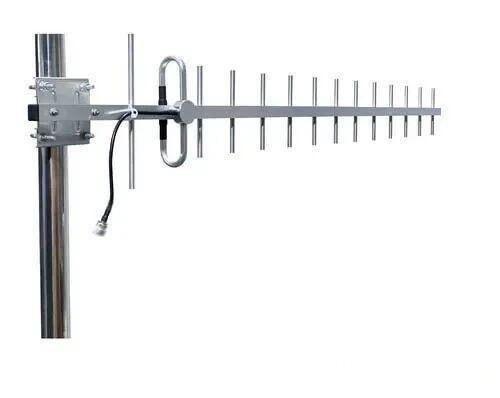 Outdoor Yagi TV Antenna


 Ceiling mount antenna
  Wall mount panel antenna
 Fiberglass Antenna
  Panel Antenna
  Parabolic Antenna
  Yagi Antenna


