


GL3924B
asialeren
8517710000
100pc
accepted
10000PC/days
| Quantity: | |
|---|---|
| PDF Export | |


Features:
SMD technology; Minimum Interference; 360 degree all directional reception; Power by STB box or extern adaptor;Buil- in high gain and low noise head amplifier; Compact design,Shine white color or black color; Good reception for both Digital and analog TV signal; Suitable for HDTV of various television standard,such as DVB-T,DVB-T2,ISDB-T, DMB-T,ATSC And DAB
TV/FM Antenna | |
GL3924B | |
Electrical Index | |
Frequency-MHz | 170-790 |
Reception Range | VHF/UHF |
ain -dBi | 25(Max) |
Output Level | 100dBu V Max |
Normal Impedance -Ω | 75 |
Power | DC 5V/50mA |
Mechanical Index | |
Connector | F or IEC |
Antenna Dimension-mm | 133*327 |
Environmentally Friendly | ROHS Compliant |
Temperature-℃ | -40~+85 |
Humidity-﹪ | 5~95 |
Packing information
Box Size: 325*140*180mm 1pcs/box
Meas: 720*340*380mm 10pcs/ctn
Loading QTY: 40HQ -7400pcs ; 20GP -3100pcs


Antenna for HDTV
A television antenna (TV aerial) is an antenna specifically designed for use with a television receiver (TV) to receive over-the-air broadcast television signals from a television station. Television reception is dependent upon the antenna as well as the transmitter. Terrestrial television is broadcast on frequencies from about 47 to 250 MHz in the very high frequency (VHF) band, and 470 to 960 MHz in the ultra high frequency (UHF) band in different countries. Television antennas are manufactured in two different types: "indoor" antennas, to be located on top of or next to the television set, and "outdoor" antennas, mounted on a mast on top of the owner's house.[1] They can also be mounted in a loft or attic, where the dry conditions and increased elevation are advantageous for reception and antenna longevity. Outdoor antennas are more expensive and difficult to install but are necessary for adequate reception in fringe areas far from television stations. The most common types of indoor antennas are the dipole[2] ("rabbit ears") and loop antennas, and for outdoor antennas the Yagi,[2] log periodic,[2] and for UHF channels the multi-bay reflective array antenna.
1. Residential Home TV Reception
Mount near a window or on a wall to replace roof antennas – enjoy free local HD channels and FM radio without monthly fees.
2. RVs & Campers
Compact size makes it perfect for motorhomes or caravans, delivering live TV and news even in remote campgrounds.
3. Rural & Fringe Areas
High 25dBi gain pulls in signals from faraway towers, ideal for countryside homes where cable or satellite is unavailable or too expensive.
4. Second TV Sets & Bedrooms
Add a lightweight indoor antenna to guest rooms, kitchens, or bedrooms for independent TV access without extra cabling.
5. FM Radio Listening
Use exclusively for FM broadcast reception (88–108MHz) to enjoy static‑free music, news, and sports on your stereo system.
Q: What frequencies does the GL3924B cover?
A: It covers 170–790MHz, which includes VHF (174–216MHz, channels 7–13) and UHF (470–790MHz, channels 14–69) as well as FM radio (88–108MHz).
Q: Does this antenna need power?
A: Yes, it requires DC 5V/50mA. You can power it via the antenna input on most modern TVs (often labelled “Antenna Power” or “5V”), or use a USB power adapter (not included).
Q: What is the actual gain? 25dBi seems very high.
A: 25dBi is the maximum gain specification, typically achieved under ideal conditions with the amplifier active. Actual reception depends on your distance to broadcast towers, obstacles, and signal environment.
Q: Which connector do I need – F or IEC?
A: F‑type is standard in North America; IEC (PAL) is common in Europe, Asia, and Australia. Please check your TV’s antenna input and select the correct version when ordering.
Q: Can I use this antenna for 4K or digital TV?
A: Yes. It receives over‑the‑air digital TV (ATSC, DVB‑T/T2, ISDB‑T). The antenna itself is format‑agnostic – as long as your TV has a digital tuner, you’ll get HD and 4K (where broadcast).
Q: How far can this antenna reach?
A: Effective range varies greatly (typically 30–70 miles / 50–110 km) depending on terrain, tower power, and obstacles. The built‑in amplifier helps in moderate fringe areas.


 External GPS Antenna
  Ceramic antenna
  Internal GPS Antenna
  Surveying Antenna
 Magnet Antenna
  Patch Antenna
  Rubber Antenna
  Screw Antenna
  Spring Antenna
  Other Indoor Coverage Antenna&outdoor Wlan Antenna
 2.4G Antenna
  5.8G Antenna

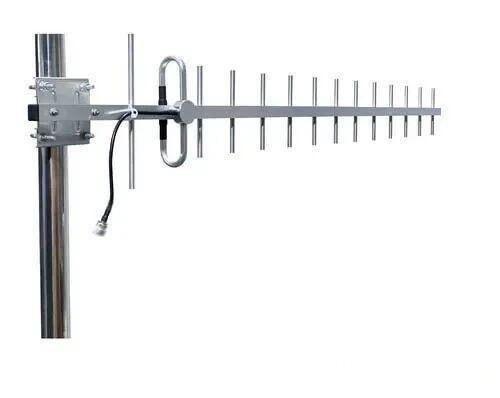 Outdoor Yagi TV Antenna


 Ceiling mount antenna
  Wall mount panel antenna
 Fiberglass Antenna
  Panel Antenna
  Parabolic Antenna
  Yagi Antenna


